Research question
What can three particles share that two cannot?
A third particle removes the Schmidt decomposition, so tripartite entanglement comes in kinds rather than amounts. For three qubits the genuinely tripartite pure states fall into two classes that no local protocol interconverts.
A worked entry into an open research direction · Sources checked 6 November 2026
The question in perspective
Take three particles whose state spaces have finite dimensions \(d_A,d_B,d_C\). A pure preparation is a vector in \(\mathcal H_A\otimes\mathcal H_B\otimes\mathcal H_C\); a general preparation is a density matrix on the same space. For two particles the pure-state question has a complete answer: every vector admits a Schmidt decomposition, a pair of matched local bases and a list of coefficients, and its entanglement is one number. Nothing of the kind survives a third particle.
The failure is structural rather than technical. For two particles the Schmidt decomposition is the singular value decomposition of the coefficient matrix, and a three-way table of coefficients is not a matrix. Written in local bases, a two-qubit state is fixed up to local unitaries by a single parameter, while a three-qubit state keeps a higher-dimensional family of invariants: states can share every single-particle entropy and still differ in kind.
The organising question is therefore convertibility. Fix the free operations — local operations with classical communication (LOCC), or the stochastic version, in which a conversion may fail but the failure is heralded — and ask which states can be turned into which. Classification then becomes a statement about resources, and it is exactly where three particles part company with two.
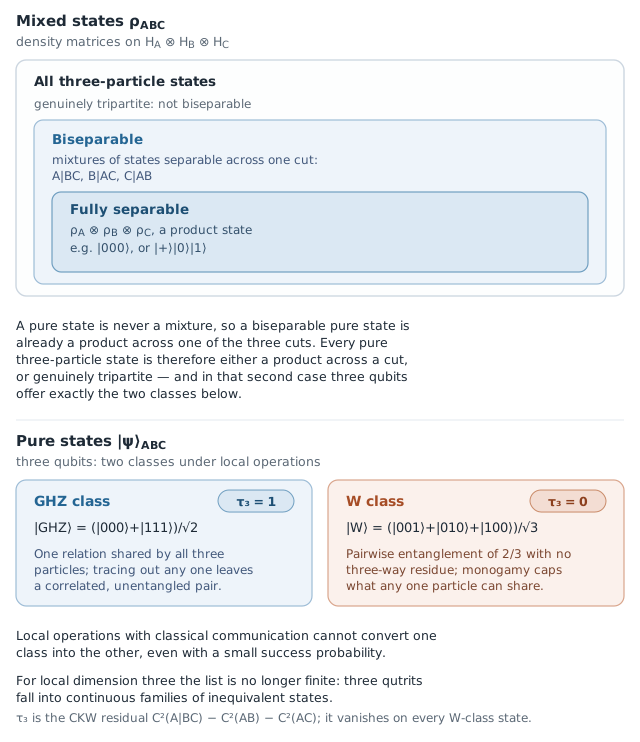
The figure separates two settings that are often conflated. For mixed states separability is a nested condition, and a state can be partly tripartite. For pure states there is no middle ground, and the genuinely tripartite class splits in two. The dimensions \(d_A,d_B,d_C\) matter throughout: the qubit case is the only one with a finite list of classes.
A worked comparison of two pure states
Write a normalized pure state of three finite-dimensional particles as
\[\ket{\psi}=\sum_{i=0}^{d_A-1}\sum_{j=0}^{d_B-1}\sum_{k=0}^{d_C-1}c_{ijk}\,\ket{i}_A\ket{j}_B\ket{k}_C, \qquad \sum_{ijk}\lvert c_{ijk}\rvert^2=1.\]
For each cut, say \(A|BC\), the coefficient table can be read as a \(d_A\times d_B d_C\) matrix, and its singular values are the Schmidt coefficients of that cut. The concurrence of a pure cut with two nonzero Schmidt weights \(\lambda_1,\lambda_2\) is \(C=2\sqrt{\lambda_1\lambda_2}\), so a maximally entangled cut reaches one. Within a pair, \(C(AB)\) is the concurrence of the reduced state \(\rho_{AB}\), computed by Wootters' construction.
Two three-qubit states with the same entanglement across \(A|BC\) separate sharply under these tests. For the GHZ state, tracing out \(C\) gives
\[\rho_{AB}=\tfrac12\bigl(\ket{00}\bra{00}+\ket{11}\bra{11}\bigr),\qquad C(AB)=0,\qquad C(A|BC)=1,\]
so the whole correlation is carried by the three-way term. For the W state,
\[\rho_{AB}=\tfrac13\bigl(\ket{00}\bra{00}+\ket{01}\bra{01}+\ket{10}\bra{10}+\ket{01}\bra{10}+\ket{10}\bra{01}\bigr),\]
whose concurrence is \(2/3\), while the \(A|BC\) Schmidt weights are \(2/3\) and \(1/3\), giving \(C(A|BC)=2\sqrt2/3\). The residual defined by Coffman, Kundu and Wootters,
\[\tau_3=C^2(A|BC)-C^2(AB)-C^2(AC),\]
takes the values \(\tau_3(\mathrm{GHZ})=1\) and \(\tau_3(\mathrm{W})=8/9-4/9-4/9=0\). The monogamy inequality \(C^2(AB)+C^2(AC)\leq C^2(A|BC)\) is the statement \(\tau_3\geq0\): whatever one particle shares with a second limits what it can share with the third. Although the formula singles out \(A\), \(\tau_3\) is the same for all three choices of cut.
The residual is a diagnostic, not a complete classifier. It vanishes on the whole W family — for example on \(\ket{001}+a(\ket{010}+\ket{100})\) for every real \(a\) — which is genuinely tripartite nonetheless. What it detects is the part of the correlation that cannot be written as a sum of pairwise shares.
What is established
Dür, Vidal and Cirac settled the three-qubit classification: under SLOCC there are exactly two classes of genuinely tripartite pure states, represented by \(\ket{\mathrm{GHZ}}\) and \(\ket{\mathrm{W}}\). No protocol converts one into the other, even with a small success probability, and the three-tangle separates them: it is nonzero on the GHZ class and zero on the W class.
Coffman, Kundu and Wootters proved the monogamy inequality for three qubits and introduced the residual \(\tau_3\), a quartic invariant of the amplitudes. For three qubits the classification and the invariant agree, so a single polynomial decides which class a pure state belongs to.
Gühne and Tóth review how multipartite entanglement is detected in practice: witness operators that separate a target set from the states reachable from it, and criteria such as the partial transpose, which is necessary for separability but not sufficient once three parties are involved. The Horodecki review places these results in the wider resource theory of entanglement and records where the multipartite case stops following the bipartite pattern.
Three scope conditions matter. These statements are about pure states unless a witness or criterion is named. They are about qubits: the finite classification does not extend to \(d\geq3\). And they assume local operations with classical communication, with no restriction on the classical messages and no cost for local computation.
What remains unresolved
For mixed states the classification is not a list but a decision problem. Biseparability is defined through a convex hull, so a certificate of genuine tripartite entanglement is one-sided: a witness or a semi-definite relaxation can prove that a state lies outside the set, while failure to find such a certificate proves nothing. How much can be decided efficiently, and with what error, remains open for the families that matter in practice.
For local dimension three and above there is no finite list of classes. Three qutrits fall into continuous families, and the quartic invariant that defines \(\tau_3\) degenerates: it no longer separates classes, so a richer set of invariants is required. Which invariants are complete, and which of them are operationally meaningful, is unresolved.
Measures are equally unsettled. Because \(\tau_3\) vanishes on every W-type state, ordering states by \(\tau_3\) is not an operational ordering: a state with \(\tau_3=0\) can be the more useful resource for a given task. Multipartite entanglement has no single currency, and the asymptotic convertibility question is answered only for restricted classes of states and operations.
A concrete next investigation
Reproduce: build the two vectors \(\ket{\mathrm{GHZ}}\) and \(\ket{\mathrm{W}}\), compute \(C(AB)\), \(C(AC)\) and \(C(A|BC)\) from the amplitudes, and check that \(\tau_3\) evaluates to one and to zero.
Check: for the family \(\cos\theta\ket{000}+\sin\theta\ket{111}\) verify \(\tau_3=\sin^2 2\theta\), so the residual interpolates between a product state and the GHZ state; then verify the monogamy inequality on random three-qubit states, where it must hold with equality exactly on the W class.
Extend: repeat the question for three qutrits, where no finite classification exists. A concrete starting point is the family \(\ket{000}+\alpha(\ket{011}+\ket{101}+\ket{110})\): compute the ranks of the three reduced states and the available invariants, and determine which members, if any, are SLOCC-equivalent to the qutrit GHZ state \(\ket{000}+\ket{111}+\ket{222}\). Ranks alone do not answer this, since both states have full-rank reductions, so a finer invariant or a witness is needed. A negative answer for the whole family would establish that this deformation stays W-like, and a positive answer at isolated values of \(\alpha\) would identify a new class boundary; either outcome is a specific claim that can be checked against the general classification programme.
Selected references
- Three qubits can be entangled in two inequivalent ways
Wolfgang Dür, Guifre Vidal, J. Ignacio Cirac. 2000. Research paper
Proves that three-qubit pure states fall into a GHZ class and a W class, and that no stochastic local protocol converts one class into the other.
- Distributed entanglement
Valerie Coffman, Joydip Kundu, William K. Wootters. 1999. Research paper
Establishes the monogamy inequality for three qubits and the residual called the three-tangle, which vanishes on the W class.
- Entanglement detection
Otfried Gühne, Géza Tóth. 2008. Review
Surveys witnesses, positive maps and moment criteria for detecting entanglement, including the multipartite case where the partial transpose is no longer sufficient.
- Quantum entanglement
Ryszard Horodecki et al.. 2007. Review
A starting point for entanglement detection, quantification, and its use as a resource.
Years refer to first arXiv submission. Publication details are available in the linked records.