Starting point: Chapters 1–11; physical concepts and approximations are introduced as needed.
Anchor example: An optically addressable electron spin and a nearby nuclear memory.
This lesson includes explanations, worked examples, and problems with solutions. Advanced results whose proofs are outside the chapter are identified explicitly.
A spin held by electrodes is read through its charge, which ties it to a chip. Some defects in a crystal also hold an electron spin, and they emit light whose brightness depends on that spin. Light can travel. Can such a defect act as a small quantum node, with an electron as the processor, a nearby nucleus as a memory, and an emitted photon as the connection to another node?
We first ask which spin levels a defect provides and why a three-level spin can be easier to address than a two-level one. Optical pumping then prepares it and microwaves rotate it. Asking where to store a qubit while the electron is busy leads to a nuclear spin, and its coupling to the electron gives conditional gates. Finally we ask how photons from two distant defects can entangle them, and why collection efficiency and memory disturbance set the rate of such a network.
Our first question is which spin levels a crystal defect provides.
12.1 Localized States
A defect is a missing or substituted atom in an otherwise regular crystal, and it can bind electrons in levels of its own. Which of those levels make a qubit, and how is it prepared and rotated? A spin with three levels, split even without a field, lets a microwave pulse pick one pair. Spin-dependent optical cycles then prepare it, and its fluorescence reads it.
12.1.1 Defects and spin levels
Why not use a single electron spin, as in a quantum dot? A spin with two levels has no splitting at zero field, so it needs a magnet to become a qubit. Some defects bind two unpaired electrons whose spins combine to a total spin of one. Such a spin has three states along an axis, labelled \(m_s=0,\pm1\).
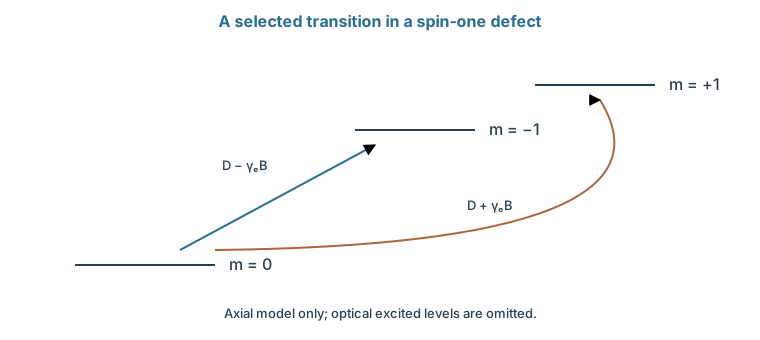
We take one example, the nitrogen-vacancy (NV) centre in diamond, and two physical inputs about it. First, the crystal around the defect separates \(m_s=0\) from \(m_s=\pm1\) by an energy \(\hbar D\) even with no applied field; for the NV centre \(D/(2\pi)\approx2.87\) GHz. Second, a field \(B\) along the defect's symmetry axis shifts \(m_s=\pm1\) by \(\pm\hbar\gamma_eB\), where \(\gamma_e=g\mu_B/\hbar\) is the electron's gyromagnetic ratio. The resulting axial model, written with a dimensionless spin-one operator \(S_z\), is
\[H=\hbar DS_z^2+\hbar\gamma_eBS_z.\]
It omits strain, a deformation of the crystal, and any field component across the axis.
Its energies are \(E_m=\hbar Dm^2+\hbar\gamma_eBm\), so the transitions from \(m_s=0\) to \(\pm1\) have angular frequencies \(D\pm\gamma_eB\). A modest field separates the two lines, and a narrow microwave pulse then selects one pair as the qubit. The third level stays present as a possible leakage state.
12.1.2 Initialization and microwave control
How is a defect spin prepared? By optical pumping, because the paths of optical excitation and decay depend on the spin state. To see how a one-way bias builds up, take a toy cycle that moves a fraction \(r\) of the unwanted-state population into the target state and never moves any back. After \(N\) cycles the unwanted population is \(p_N=p_0(1-r)^N\). Real cycles also pump some population the wrong way, which leaves a nonzero limit, so the prepared population must be measured.
Once prepared, the spin is rotated by microwaves resonant with the selected transition, with the Rabi dynamics we derived. The same optical cycle reads it, since the fluorescence is brighter for one spin state; the two photon-count distributions overlap, as in any threshold readout. Strong optical reset of the electron can also disturb nearby nuclear spins, so preparation is tested on the whole node, not only on the electron.
Selecting two levels does not remove the third. The displayed frequencies follow from D Sz² + γe B Sz; strain, transverse fields, and optical levels require a fuller model.
Problem 12.1. Take \(D/(2\pi)=2.87\) GHz and \(\gamma_eB/(2\pi)=0.1\) GHz in the axial model. What are the two transition frequencies, and which pair does a narrow 2.97 GHz pulse address?
Worked solution
The lines are at \(2.87\mp0.1\) GHz, that is 2.77 GHz and 2.97 GHz. The 2.97 GHz pulse addresses \(m_s=0\leftrightarrow+1\) in this sign convention, and \(m_s=-1\) remains a leakage level 0.2 GHz away.
12.2 Spin Registers
The electron is needed for optical attempts and readout, which disturb whatever it stores. Where can a qubit wait meanwhile, and how do the electron and that store interact? A nuclear spin nearby couples to the electron only weakly, which makes it a quiet memory. Keeping only the part of that coupling that survives the large energy mismatch gives a ZZ interaction and a conditional gate.
12.2.1 Nuclear memories
Where can a qubit wait while the electron is busy? In a nearby nuclear spin, whose magnetic moment is far smaller than the electron's, so stray fields disturb it less. The electron and nucleus interact magnetically. Treat each as two-level. The full interaction contains terms that flip one spin while leaving the other. The electron's splitting is much larger than the coupling, so such terms are strongly mismatched, and by the rotating-wave argument they average out. The part that survives, called the secular interaction, is
\[H_{\rm int}=\hbar AZ_eZ_n/4,\]
with \(A\) an angular frequency.
What does it do to the nucleus? With the electron's Z value fixed at \(s=\pm1\), the nuclear Hamiltonian changes by \(s\hbar AZ_n/4\). The nuclear transition frequency therefore shifts in opposite directions for the two values of \(s\), and the two lines are separated by \(|A|\). A pulse narrow enough to resolve that separation acts on the nucleus only for one electron state. The same coupling is a hazard during storage: if the electron flips unexpectedly, the nuclear phase accumulates at the wrong rate. So an idle nuclear coherence time does not predict the memory's quality while the electron is repeatedly reset and excited.
12.2.2 Conditional operations
Can the secular interaction alone make a controlled gate? In the basis 00, 01, 10, 11, it gives the phases \((-At/4,+At/4,+At/4,-At/4)\). Their local-phase-invariant combination is \(-At\). Choosing \(At=\pi\) therefore gives a controlled sign after local Z corrections, exactly as for the ZZ coupling between two qubits.
The phase difference between one even and one odd basis state is only \(At/2\), and it must not be confused with the invariant conditional phase. A selective microwave or radio-frequency pulse gives a conditional operation by a second route, using the resolved transition frequencies instead of accumulated phase. Its selectivity must be large compared with spectator nuclear couplings, since every extra nucleus that helps a gate also couples to the memory.
Problem 12.2. What is the magnitude of the phase difference between one even-parity and one odd-parity basis state under the stated interaction?
Worked solution
The energies are \(\pm\hbar A/4\), so their phase difference has magnitude \(At/2\). Single-spin phases and the sign convention must be tracked when specifying a target gate.
12.3 Optical Interfaces
A node becomes part of a network only when its qubit can be entangled with a qubit far away. How can photons do that, and how fast? If a detector click cannot reveal which node emitted, the click leaves the two nodes entangled. Counting the photons that must be collected then gives the rate, and the memory must survive every failed attempt.
12.3.1 Readout and heralded entanglement
How can light entangle two distant spins that never interact? Let each node emit a photon whose presence or properties depend on its spin, and send both photons to a beam splitter in the middle. If a detection could have come from either node, it carries no information about which one emitted. The click pattern then announces, or heralds, a joint spin state that is entangled. The accepted pattern and the overlap of the two photons' modes fix that state.
Is a click enough? No. Background light and photons that can be told apart produce the same classical record without the coherence. So the quality of the heralded state depends on how identical the photons are, not only on whether a detector fired.
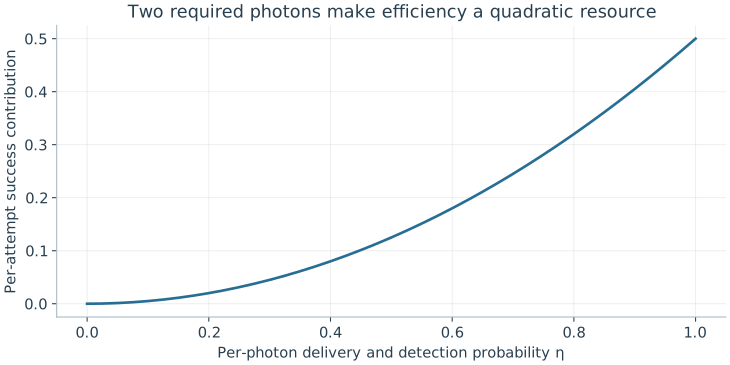
How often does it succeed? A remote protocol that needs two photons adds collection, transmission, detector efficiency, and an allowed pattern of coincidences. If each required photon is detected with probability \(\eta\) and an accepted pattern has conditional probability \(q\), the success probability per attempt is \(s=q\eta^2\), assuming independence. This is the rate model for that protocol, not a formula for every heralded scheme.
12.3.2 Collection efficiency and scaling
What does a small collection efficiency cost? At \(\eta=0.1\), two required photons contribute only 0.01, before \(q\) and other imperfections. For attempts spaced by \(\tau\), the mean waiting time is \(\tau/s\). Because the photon requirement is squared, raising the collection efficiency speeds up the network quadratically in this model.
What happens to the stored qubit during the wait? It must survive idle evolution and repeated optical disturbance. Suppose each failed attempt keeps a fraction \(c\) of its coherence, and attempts succeed independently with probability \(s\). Success on attempt \(n\) has probability \(s(1-s)^{n-1}\) and follows \(n-1\) failures, so the mean surviving factor at first success is
before idle decay is included. When success is rare, even a small disturbance per attempt matters. So a fidelity conditioned on success is meaningful only together with the number of attempts and the memory's behaviour during them.
This two-photon toy rate assumes independent detection and accepted-pattern factor q = 1/2. Conditional state quality also depends on mode overlap and false detections.
Problem 12.3. Why benchmark a memory during link attempts?
Worked solution
Optical excitation and reset can perturb the memory. Its idle coherence time does not capture those repeated disturbances; the relevant experiment reproduces the actual network duty cycle.
Photons carried entanglement between nodes here. Could photons carry the computation itself, even though they barely interact with one another?
Worked model check. Each required photon is detected with probability 0.2, accepted-pattern factor q is 0.5, and attempts take 10 μs. Estimate mean waiting time.
Worked solution
\(s=0.5(0.2)^2=0.02\); mean attempts are 50, so mean wait is 500 μs. False clicks and memory disturbance are excluded from this rate calculation.
Point defects in wide-bandgap crystals—such as nitrogen-vacancy (NV) and silicon-vacancy (SiV) centers in diamond—host optically addressable electronic spins with long coherence even at elevated temperatures.
The central electronic spin couples via hyperfine interactions to nearby nuclear spins (such as \(^{13}\mathrm{C}\)), which act as long-lived quantum memory registers.
Spin-selective optical transitions entangle remote defect centers by heralded photon interference, making color centers prime nodes for quantum networks and nanoscale sensing.
Questions and worked problems
These exercises draw on the whole chapter. Attempt each question before opening a hint, explain your reasoning, then compare it with the worked solution.
For the axial spin-one model with \(D/2\pi=2.87\) GHz, \(\gamma_e/2\pi=28\) GHz/T, and \(B=10\) mT, find the two transition frequencies \(D\pm\gamma_eB\) and their separation. Why does the field make one transition addressable as a qubit?
Hint 1
\(\gamma_eB/2\pi=280\) MHz.
Hint 2
A narrow pulse resolves lines separated by much more than its Rabi rate.
Worked solution
The transitions are at \(2.87\pm0.28\) GHz: \(3.15\) GHz and \(2.59\) GHz, separated by \(560\) MHz. A microwave pulse with a Rabi rate far below \(560\) MHz drives only one transition, so \(m_s=0\) and one of \(m_s=\pm1\) form the qubit. The other level is still there, as a leakage state for strong or poorly shaped pulses.
Optical pumping removes a fraction \(r=0.3\) of the unwanted population per cycle, starting from \(p_0=0.5\). Find the unwanted population after \(10\) cycles, and the number of cycles needed to reach \(10^{-3}\) in this toy model. Why is the real limit usually higher?
Hint 1
\(p_N=p_0(1-r)^N\).
Hint 2
Solve \(0.5\times0.7^N\le10^{-3}\).
Worked solution
After \(10\) cycles, \(0.5\times0.7^{10}\approx0.014\). Reaching \(10^{-3}\) needs \(0.7^N\le0.002\), so \(N\ge18\). Real pumping also has reverse processes and branching to other levels, giving a nonzero limiting population that no number of cycles can remove; it must be measured.
A two-photon remote protocol needs both photons detected, each with probability \(\eta=0.05\), and accepts a pattern with \(q=0.5\). Attempts take \(5\) μs. Find the success probability per attempt and the mean waiting time.
Hint 1
\(s=q\eta^2\).
Hint 2
Mean wait \(\tau/s\).
Worked solution
\(s=0.5\times0.0025=1.25\times10^{-3}\), so the mean wait is \(5\ \mu\mathrm s/1.25\times10^{-3}=4\) ms. Halving the collection efficiency would quadruple this. Collection is the dominant lever in two-photon schemes.
A nuclear memory keeps coherence factor \(c\) per failed link attempt, and attempts succeed with \(s=10^{-3}\). (a) Using \(s/[1-(1-s)c]\), find the mean coherence factor at first success for \(c=0.9999\) and \(c=0.999\). (b) Interpret the second result. (c) How small must \(1-c\) be compared with \(s\) for the memory to be useful?
Hint 1
\(1-(1-s)c\approx s+(1-c)\) when both are small.
Hint 2
So the factor is about \(s/(s+1-c)\).
Worked solution
(a) For \(c=0.9999\): \(10^{-3}/(1-0.999\times0.9999)\approx0.91\). For \(c=0.999\): about \(0.50\). (b) A per-attempt disturbance of only \(10^{-3}\) halves the stored coherence on average, because about a thousand attempts are needed. (c) Since the factor is about \(s/(s+1-c)\), the memory is useful only if \(1-c\ll s\): the disturbance per attempt must be much smaller than the success probability per attempt. Idle coherence times say nothing about this.
An electron–nuclear interaction \(H=\hbar AZ_eZ_n/4\) has \(A/2\pi=200\) kHz. (a) How long must it act to give a controlled sign (invariant phase \(At=\pi\))? (b) During storage, the electron flips unexpectedly at time \(t_f\) within a period of length \(t\). Show that the nuclear phase then differs from the intended one by an amount proportional to \(A(t-t_f)\). (c) Why does this make electron reset dangerous for nuclear memories?
Hint 1
\(t=\pi/A\).
Hint 2
The nuclear precession rate is \(\pm A/2\) depending on the electron state.
Worked solution
(a) \(t=\pi/A=1/(2\times200\ \text{kHz})=2.5\) μs. (b) The nuclear transition frequency shifts by \(\pm A/2\) depending on the electron state. If the electron flips at \(t_f\), the nucleus precesses at the other rate for the remaining \(t-t_f\), accumulating an extra phase of \(A(t-t_f)\) relative to the intended evolution. (c) Electron reset during link attempts flips the electron at random times, adding random nuclear phases of order \(A\) times the time the electron spends in the wrong state; with a large \(A\) a single reset can scramble the memory. Weakly coupled nuclei, or decoupling sequences, reduce this sensitivity.
A nuclear transition is shifted by \(\pm A/2\) with \(A/2\pi=2\) MHz depending on the electron state. A resonant radio-frequency pulse targets the transition for one electron state. (a) Using \(\Omega^2/(\Omega^2+\Delta^2)\) with \(\Delta=A\), estimate the unwanted rotation for \(\Omega/2\pi=200\) kHz. (b) What Rabi frequency keeps it below \(10^{-4}\), and what pulse duration does that imply? (c) What competes with longer pulses?
Hint 1
\(\Delta/\Omega=10\).
Hint 2
Require \(\Delta/\Omega\ge100\).
Worked solution
(a) \(1/(1+100)\approx0.0099\). (b) \(\Delta/\Omega\ge100\) requires \(\Omega/2\pi\le20\) kHz, so a \(\pi\) pulse takes \(1/(2\times20\ \text{kHz})=25\) μs. (c) Longer pulses expose both spins to decoherence and to electron state changes; shaped pulses, or conditional gates based on the interaction phase itself, achieve selectivity faster.
Room-temperature fluorescence readout of a defect gives, per shot, mean detected counts \(0.050\) for the bright state and \(0.035\) for the dark state. (a) Why is single-shot readout impossible here? (b) For \(N\) repeated shots, the difference in total counts is \(0.015N\) while the shot noise is about \(\sqrt{0.0425N}\). How many shots are needed for a signal-to-noise ratio of \(3\)? (c) How do repetitive nuclear-assisted readout schemes change this?
Hint 1
With fewer than one photon per shot, most shots record nothing in both states.
Hint 2
Solve \(0.015\sqrt N/\sqrt{0.0425}=3\).
Worked solution
(a) Most shots detect no photon in either state, and the count distributions overlap almost completely, so one shot cannot decide. (b) \(0.015\sqrt N/\sqrt{0.0425}=3\) gives \(N\approx1700\) repetitions with fresh preparations: an average, not a single-shot measurement. (c) Mapping the electron state onto a nuclear spin and then reading the electron many times, re-mapping in between, accumulates photons from one preparation, approaching single-shot readout of the nucleus, because the nuclear state survives many optical cycles.
A student wants a controlled sign from the electron–nuclear interaction and argues: “Even and odd basis states differ in phase by \(At/2\); a controlled sign needs a phase difference \(\pi\), so I choose \(At=2\pi\).” What gate results, and what is the correct choice?
Hint 1
The invariant combination is \(\phi_{00}-\phi_{01}-\phi_{10}+\phi_{11}=-At\).
Hint 2
An invariant of \(2\pi\) is equivalent to none.
Worked solution
The local-phase-invariant combination is \(-At\). At \(At=2\pi\) it equals \(-2\pi\), which is no conditional phase at all: the gate is a product of local \(Z\) rotations, and it entangles nothing. A controlled sign needs the invariant to be \(\pi\), so \(At=\pi\), after which local corrections remove the remaining single-qubit phases. The even–odd difference \(At/2\) is a real phase but not the quantity that local operations cannot remove.
Two nodes \(L\) km apart are linked through a midpoint station by fiber with loss \(0.2\) dB/km, so each photon travels \(L/2\). (a) Find the transmission per photon for \(L=50\) km. (b) Compare the success scaling of a two-photon protocol (\(s\propto\eta^2\)) with a single-photon protocol (\(s\propto\eta\)) at this distance. (c) What trade-off do single-photon schemes usually accept?
Hint 1
\(25\) km gives \(5\) dB, a factor \(10^{-0.5}\).
Hint 2
The two-photon rate scales as transmission squared.
Worked solution
(a) \(25\) km of fiber gives \(5\) dB, transmission \(10^{-0.5}\approx0.32\). (b) A two-photon protocol loses \(0.32^2\approx0.1\) from fiber alone; a single-photon protocol loses only \(0.32\), about three times better, and the advantage grows with distance. (c) Single-photon schemes need interferometric phase stability over the whole link and typically trade fidelity for rate (they herald a state with a known admixture of the wrong component), whereas two-photon schemes are more robust to phase drift but slower.
A node holds \(M\) independent communication qubits and attempts entanglement with all of them in parallel each round, with success probability \(s=10^{-3}\) per qubit. (a) Find the probability that at least one succeeds in a round, for \(M=1\) and \(M=50\). (b) By how much does the mean waiting time fall? (c) What new requirements does multiplexing impose?
Hint 1
\(1-(1-s)^M\approx Ms\) for \(Ms\ll1\).
Hint 2
\(1-(0.999)^{50}\approx0.049\).
Worked solution
(a) \(M=1\): \(10^{-3}\). \(M=50\): \(1-0.999^{50}\approx0.049\). (b) The mean number of rounds falls from \(1000\) to about \(20\), nearly fifty-fold. (c) Multiplexing needs many optically addressable qubits per node, distinguishable photons (in time, frequency, or space) so the detector knows which qubit succeeded, and memories that are not disturbed by the attempts on their neighbours. The rate gain is paid for in hardware and crosstalk control.