Starting point: Chapters 1–12; physical concepts and approximations are introduced as needed.
Anchor example: A dual-rail qubit passing through a balanced beam splitter.
This lesson includes explanations, worked examples, and problems with solutions. Advanced results whose proofs are outside the chapter are identified explicitly.
Every platform so far stores its qubits in matter and uses light as a control or a messenger. Light barely interacts with anything, which is why a photon can travel far without losing its coherence. The same weakness makes it hard for one photon to control another. Can photons carry the computation itself?
We first describe light as a set of modes, each an oscillator, and encode a qubit in which of two modes holds a single photon. Beam splitters and phase shifts then give single-qubit gates through interference of paths. Asking what two photons do at a beam splitter reveals the one effect passive optics offers between photons, two-photon interference. Detecting extra photons and keeping only accepted outcomes turns that effect into heralded entangling operations. Finally we ask what photon loss, detector efficiency, and probabilistic sources cost, and how many sources and switches a reliable supply of photons needs.
Our first question is how a single photon can hold a qubit.
13.1 Optical Qubits
A photon can take two paths coherently, and a beam splitter mixes those paths. How do we describe photons precisely enough to say what state a source makes and what a beam splitter does? Treating each pattern of the light field as an oscillator gives modes and creation operators. Encoding a qubit in two modes then reduces single-qubit gates to interference between paths.
13.1.1 Encoding and sources
What exactly holds a photon? Light in a given path, polarization, frequency band, and time window behaves as one harmonic oscillator. Each such pattern of the field is called a mode, and its excitation number is the number of photons in it. The empty field is the vacuum \(\ket{\mathrm{vac}}\). The raising operator of a mode, here called its creation operator \(a^\dagger\), adds one photon: \(a^\dagger\ket{\mathrm{vac}}\) is one photon in that mode.
How can one photon encode a qubit? Put it in one of two modes \(0\) and \(1\), for example two paths: \(\ket{0_L}=\ket{1,0}\) and \(\ket{1_L}=\ket{0,1}\), where the entries count photons in each mode. A general qubit is \((a\,a_0^\dagger+b\,a_1^\dagger)\ket{\mathrm{vac}}\), with \(|a|^2+|b|^2=1\). This is dual-rail encoding. Both logical states contain one photon, so neither is the vacuum.
What must a source do? It must prepare exactly one photon in the intended mode. Vacuum and extra photons lie outside the two-dimensional encoding. Suppose a source produces vacuum with probability \(v\), and the readout simply discards trials with no click. The retained trials can look excellent, while the unconditional success is at most \(1-v\). So the probability of preparing a photon is a separate figure from the quality of the qubits that remain.
13.1.2 Interference and phase control
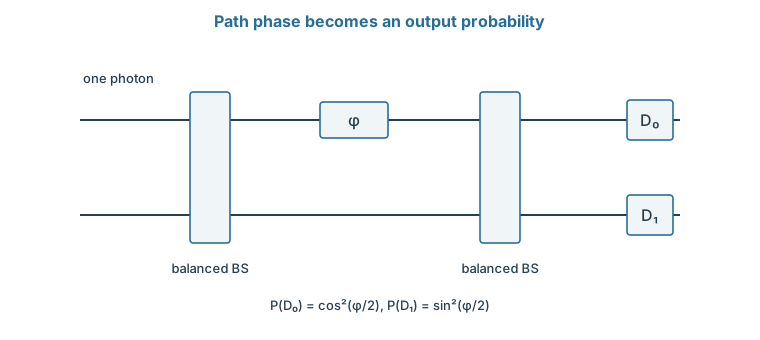
How do we rotate a dual-rail qubit? With a beam splitter, which mixes two modes. Choose the real balanced convention with mode matrix \(B=2^{-1/2}\begin{pmatrix}1&1\\1&-1\end{pmatrix}\). Its columns are orthonormal, so it preserves the total one-photon probability. A photon entering the first rail leaves with equal amplitudes in the two outputs.
What turns those amplitudes into a chosen outcome? A phase plate in the second path multiplies its amplitude by \(e^{i\phi}\). A second identical beam splitter then gives output amplitudes \((1+e^{i\phi})/2\) and \((1-e^{i\phi})/2\), with probabilities \(\cos^2(\phi/2)\) and \(\sin^2(\phi/2)\). This is the interference of amplitudes from quantum computing, carried out by physical paths. Loss, drift in path length, and imperfect overlap of the modes reduce the contrast, and they must be told apart from an intended phase shift.
The two horizontal lines are optical modes, not two photons. A single photon occupies a coherent superposition of paths. The probability formulas use the real beam-splitter convention stated in the text.
Problem 13.1. What happens to a dual-rail qubit if its photon is lost?
Worked solution
The state leaves the one-photon subspace and becomes vacuum in the two rails. This is not the logical zero, which still contains one photon.
13.2 Photonic Gates
Single-photon gates need only linear optics. What can two photons do to each other when they never interact? At a beam splitter, two identical photons interfere as a pair, which is the only joint effect passive optics gives. Detecting extra photons and keeping only accepted outcomes then converts that effect into an entangling operation that succeeds with some probability.
13.2.1 Two-photon interference
What happens when one photon enters each input of a balanced beam splitter? Track creation operators. A photon entering a mode leaves in the output modes \(c\) and \(d\) with the amplitudes of the corresponding column of \(B\), so \(a^\dagger\mapsto(c^\dagger+d^\dagger)/\sqrt2\) and \(b^\dagger\mapsto(c^\dagger-d^\dagger)/\sqrt2\). Creation operators of different modes commute, \(c^\dagger d^\dagger=d^\dagger c^\dagger\), because photons are bosons. Multiplying out,
The two terms with one photon in each output cancel. The factor \(\sqrt2\) comes from \((c^\dagger)^2\ket{\mathrm{vac}}=\sqrt2\ket{2,0}\), by the raising rule. So identical photons always leave together. This is Hong–Ou–Mandel interference.
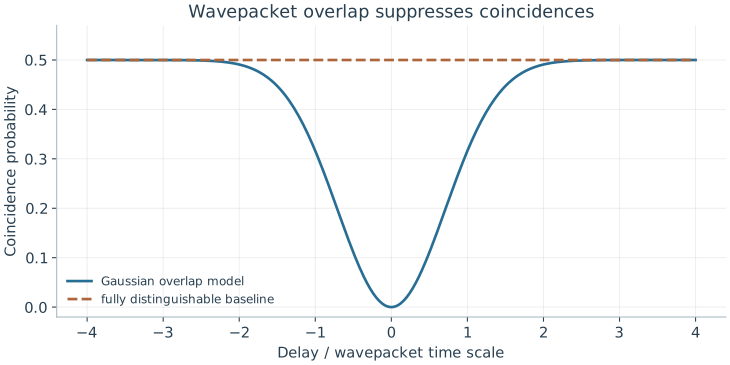
What if the photons differ? If some other property, such as arrival time, labels which photon is which, the cancelling alternatives become distinguishable and need not cancel. We quote the result for pure wavepackets with overlap \(\mu\): the probability of one photon in each output is \((1-|\mu|^2)/2\). Indistinguishability is therefore a measurable control requirement.
13.2.2 Measurement-induced operations
Can beam splitters alone entangle two dual-rail qubits? We quote a known result: passive linear optics on its own gives no deterministic entangling gate between such qubits. Detection can supply what is missing. Add extra photons in ancillary modes, apply a linear-optical unitary \(U\), detect the ancillary modes, and keep only an accepted outcome \(m\). The data then undergo the conditional operator \(K_m=\bra mU\ket{\mathrm{ancilla}}\).
When does this act as a gate? The accepted output is \(K_m\ket\psi/\sqrt{p_m}\), with \(p_m=\|K_m\ket\psi\|^2\). For the same heralded unitary \(U_0\) to act on every logical input with the same success probability \(s\), we need \(K_m=\sqrt s\,U_0\) on the code space. Otherwise keeping only accepted outcomes distorts the amplitudes or favours some inputs. Knill, Laflamme, and Milburn proved that such heralded gates, with additional resources, give a scalable route to computation; that theorem goes beyond this small calculation.
For the assumed squared overlap |μ|² = exp[−(delay/τ)²], the ideal probability is (1−|μ|²)/2. This is an analytical overlap model, not a fitted experimental dip.
Problem 13.2. What is the ideal coincidence probability for one identical photon in each balanced input?
Worked solution
Zero: expanding the creation operators cancels the term with one photon in each output. For fully distinguishable photons the probability is one half.
13.3 Detection and Architecture
Heralded gates and readout both depend on detectors, and every photon can be lost on the way. How does loss enter the statistics, and how can probabilistic sources supply photons on demand? Treating an imperfect detector as loss followed by ideal detection gives the click probabilities. Running many sources in parallel and switching out a successful photon then trades source count against switching loss.
13.3.1 Loss and heralding
How does an imperfect detector change the statistics? Model it as a loss with transmission \(\eta\), followed by ideal detection. For \(n\) independent photons, no detection occurs with probability \((1-\eta)^n\), so at least one photon is detected with probability \(1-(1-\eta)^n\). A threshold detector reports only whether it clicked, while a number-resolving detector counts photons.
What does loss do to a dual-rail qubit? It moves the state to vacuum. The loss can be flagged only when a later measurement checks that a photon is still present, and a final detection destroys the photon in any case. Dark counts, clicks without a photon, can also turn an absent photon into an apparent success. Source probability, transmission, detection efficiency, false clicks, and the accepted outcomes each affect the rate and the conditional fidelity differently, so each is counted separately.
13.3.2 Resource states and multiplexing
Can unreliable sources supply photons on demand? If one source succeeds with probability \(s\), then \(M\) independent sources all fail with probability \((1-s)^M\). At least one photon is available with probability \(1-(1-s)^M\). At \(s=0.1\), ten sources give 0.6513, before any routing loss. Running sources in parallel this way is called multiplexing.
What does routing cost? Suppose that selecting the successful photon takes \(\lceil\log_2M\rceil\) switching stages, each with transmission \(\eta_s\). In a simplified balanced tree, the delivered availability is \([1-(1-s)^M]\eta_s^{\lceil\log_2M\rceil}\). More sources raise production, while deeper switching loses photons.
The same trade-off appears at larger scale. One photonic architecture prepares large entangled states of many photons in advance, called resource states, and computes by measuring their photons one at a time. The resource states are assembled by small heralded entangling measurements called fusions, each of which can fail. Every failed fusion costs photons, time, and delay-line storage, so the architecture is set by sources, interferometers, switches, delays, and detectors together.
Problem 13.3. If independent sources succeed with probability 0.1, what is the chance that at least one of ten succeeds?
Worked solution
It is 1 − 0.9¹⁰ ≈ 0.6513, before switching loss. Multiplexing improves availability but does not eliminate the cost of routing the successful photon.
A mode can hold more than one photon. Could the many levels of a single mode store a qubit so that losing a photon leaves a detectable trace instead of destroying it?
Worked model check. Ten sources each succeed with probability 0.1. Four required switching stages each transmit with probability 0.95. Estimate delivered availability.
Worked solution
\([1-0.9^{10}]0.95^4\simeq0.5305\). This model counts delivery of at least one selected photon; it does not certify its mode or logical quality.
Photons encode qubits in polarization, dual-rail path, time-bin, or frequency modes that propagate with negligible thermal decoherence at room temperature.
Because photon–photon interactions in linear media are vanishingly weak, Knill–Laflamme–Milburn (KLM) and fusion-based architectures induce effective entangling gates through Hong–Ou–Mandel interference, ancilla photons, and heralding photodetectors.
Photon loss is the dominant error channel in integrated photonic circuits, driving architectural shifts toward measurement-based cluster states and multiplexed resource-state generators.
Questions and worked problems
These exercises draw on the whole chapter. Attempt each question before opening a hint, explain your reasoning, then compare it with the worked solution.
In a Mach–Zehnder interferometer built from the balanced beam splitter of the text, the phase plate is set to \(\phi=\pi/3\). Find the output probabilities. Which phase sends the photon to the second output with certainty?
Hint 1
Probabilities \(\cos^2(\phi/2)\) and \(\sin^2(\phi/2)\).
Hint 2
\(\cos^2(\pi/6)=3/4\).
Worked solution
\(\cos^2(\pi/6)=0.75\) and \(\sin^2(\pi/6)=0.25\). The second output is certain at \(\phi=\pi\). A dual-rail single-qubit gate is just a choice of beam splitters and phases; drift in \(\phi\) is a rotation error, while loss lowers both outputs together.
Two photons with wavepacket overlap \(|\mu|^2=0.9\) enter the two inputs of a balanced beam splitter. Find the coincidence probability. What value would perfectly distinguishable photons give?
Hint 1
Coincidence probability \((1-|\mu|^2)/2\).
Hint 2
Distinguishable means \(\mu=0\).
Worked solution
\((1-0.9)/2=0.05\). Perfectly distinguishable photons give \(\frac12\), like classical particles choosing outputs independently. The drop from \(0.5\) to \(0.05\) measures indistinguishability, a resource that every interference-based photonic gate needs.
A threshold detector has efficiency \(\eta=0.8\). Find the click probability for one photon and for three photons arriving together. Can the detector tell these cases apart?
Hint 1
No click requires every photon to be missed.
Hint 2
\(1-(1-\eta)^n\).
Worked solution
One photon: \(0.8\). Three photons: \(1-0.2^3=0.992\). A threshold detector reports only “click” or “no click,” so a click does not reveal whether one or three photons arrived. That matters when heralding single photons, because multiphoton events then pass as successes; number-resolving detectors are needed to reject them.
Multiplexed sources each succeed with \(s=0.1\), and selecting one requires \(\lceil\log_2M\rceil\) switch stages of transmission \(0.97\). (a) Evaluate the delivered availability for \(M=8,16,32,64,128\). (b) Which \(M\) is best? (c) What limits further improvement?
(a) \(M=8\): \(0.520\); \(16\): \(0.721\); \(32\): \(0.829\); \(64\): \(0.832\); \(128\): \(0.808\). (b) The optimum is near \(M=32\) to \(64\). (c) Once almost every round produces a photon, extra sources add nothing, while each doubling adds a switch stage that loses \(3\%\). The ceiling is \(0.97^{\lceil\log_2M\rceil}\), so switch transmission, not source probability, limits delivered availability; better switches raise the optimum and the ceiling together.
For wavepackets with \(|\mu|^2=e^{-(\text{delay}/\tau)^2}\), (a) find the coincidence probability at a delay of \(\tau/2\); (b) a measured coincidence of \(0.20\) implies what delay; (c) explain how scanning the delay calibrates timing between sources.
Hint 1
\(e^{-0.25}\approx0.779\).
Hint 2
Solve \((1-|\mu|^2)/2=0.20\).
Worked solution
(a) \(|\mu|^2\approx0.779\), coincidence \(\approx0.11\). (b) \(|\mu|^2=0.6\), so \((\text{delay}/\tau)^2=-\ln0.6\approx0.51\) and the delay is about \(0.71\tau\). (c) Scanning the delay traces the dip; its minimum locates zero relative delay and its depth measures the best achievable indistinguishability. A dip that does not reach the ideal depth reveals spectral or polarization mismatch rather than timing.
A heralded operation has conditional operator \(K=\mathrm{diag}(\frac12,\frac{1}{\sqrt2})\) on the logical basis. (a) For input \(\ket+\), find the success probability and the accepted output. (b) Compute its fidelity with \(\ket+\). (c) What condition on \(K\) makes the heralded operation faithful for every input?
(a) \(K\ket+=\frac{1}{\sqrt2}(\frac12\ket0+\frac{1}{\sqrt2}\ket1)\), so \(p=\frac12(\frac14+\frac12)=0.375\), and the accepted output is \((\ket0+\sqrt2\ket1)/\sqrt3\). (b) Fidelity \(|1+\sqrt2|^2/6\approx0.971\). (c) \(K\) must equal \(\sqrt s\,U_0\) on the code space: proportional to a unitary, so every input succeeds with the same probability and is transformed without distortion. Unequal diagonal entries mean the heralding itself acts as a partial measurement.
A source emits vacuum with probability \(v=0.3\) and otherwise a perfect single photon. (a) A protocol needs four photons simultaneously from four independent sources. Find the unconditional success probability. (b) Postselection on four clicks reports a conditional fidelity of \(0.99\). Why is this incomplete? (c) How does multiplexing with \(M=4\) sources per required photon change the success?
Hint 1
Four independent successes: \((1-v)^4\).
Hint 2
With \(M\) sources, a slot fails only if all \(M\) emit vacuum.
Worked solution
(a) \(0.7^4\approx0.24\). (b) The conditional fidelity describes accepted runs only; three-quarters of runs fail, and the rate, along with any bias the postselection introduces, must be reported. (c) Each slot then fails with \(0.3^4\approx0.008\), so all four slots succeed with \(0.992^4\approx0.97\) before switch losses. Multiplexing converts probabilistic sources into nearly deterministic ones at the cost of switches and more hardware.
A student treats every herald click as a single photon. A source produces one photon with probability \(0.1\), two photons with probability \(0.005\), and otherwise vacuum, and the herald detector has \(\eta=0.9\) with threshold response. (a) Find the probability of a click and the fraction of clicks that came from two-photon events. (b) Why does this matter for photonic gates?
(a) Click probability \(=0.1\times0.9+0.005\times0.99\approx0.090+0.005=0.095\). Two-photon events make up about \(0.005/0.095\approx5\%\) of clicks. (b) A two-photon input lies outside the dual-rail code space: it ruins interference (it contributes coincidences in a two-photon interference test) and can produce false heralds in measurement-induced gates. Multiphoton contamination must be suppressed at the source or detected with number-resolving heralds.
Replace the balanced beam splitter by a real unbalanced one, \(B=\begin{pmatrix}t&r\\r&-t\end{pmatrix}\) with \(t^2+r^2=1\). For one identical photon in each input, (a) show that the coincidence amplitude is \(t^2-r^2\) up to sign; (b) evaluate the coincidence probability for \(t^2=0.6\); (c) explain why balanced splitting is needed for complete cancellation.
(a) \(a^\dagger b^\dagger\mapsto(tc^\dagger+rd^\dagger)(rc^\dagger-td^\dagger)\). The \(c^\dagger d^\dagger\) coefficient is \(-t^2+r^2\), so the coincidence probability is \((t^2-r^2)^2\). (b) \((0.6-0.4)^2=0.04\). (c) The two paths to a coincidence (both transmitted, both reflected) cancel only if their amplitudes have equal magnitude, \(t^2=r^2=\frac12\). Imbalance leaves a floor in the dip even for perfectly identical photons, so interference visibility mixes beam-splitter imbalance with photon distinguishability.
A photonic architecture fuses small resource states with probabilistic operations that succeed with probability \(\frac12\) and herald failure. (a) What is the probability that \(10\) independent fusions all succeed on the first attempt? (b) If each failed fusion can be retried with fresh resources, what is the expected number of attempts per successful fusion, and per \(10\) fusions? (c) How does loss change the picture?
Hint 1
\(2^{-10}\approx10^{-3}\).
Hint 2
Geometric distribution: mean \(1/p\) attempts.
Worked solution
(a) \(2^{-10}\approx0.001\). (b) Each fusion needs \(2\) attempts on average, so \(10\) fusions need about \(20\), and the extra resource states and storage must be counted. (c) Loss makes some failures unheralded or erases photons that the next fusion needed, so the cost grows faster, and architectures use larger, more redundant resource states so that the computation survives a fraction of failed and lost fusions.