Starting point: Qubit states, unitaries and projective measurement; tensor products are developed by pairing configuration labels.
Keep in view: A Bell pair contrasted with independent preparations.
We can now describe one qubit completely. A state is a normalized vector of complex amplitudes. An isolated qubit evolves by a unitary matrix, and a measurement gives an outcome with probability fixed by the inner product. One observation escaped this description: a device that records a photon's path destroys its interference.
The recorder is a second system, so we need states for two systems at once. How many amplitudes does a pair need, and how do they relate to the amplitudes of each part? Pairing the configurations gives four joint amplitudes, and independent preparations multiply. A joint operation then produces a state that is not of that product form, which is entanglement. Measuring such a state shows why the path record kills interference. Comparing it with a random mixture of the same outcomes shows that entanglement is a property of amplitudes, not of correlated counts in one basis.
4.1 Joint States
Alice and Bob each hold a qubit. What state describes the pair? We first build joint amplitudes for two independently prepared qubits, which gives the tensor product. Then we ask what an operation on one qubit does to the pair, and what operation could make one qubit's label depend on the other's. That operation, CNOT, produces a state we cannot yet classify.
A pair of qubits has four joint configurations: 00, 01, 10 and 11. We always write Alice's label first. Suppose Alice prepares \(a\ket0+b\ket1\) and Bob, separately, prepares \(c\ket0+d\ket1\). What is the amplitude for the joint configuration 01?
For independent classical events we multiplied probabilities. Amplitudes follow the same pattern: Alice's qubit must be in 0, with amplitude \(a\), and Bob's in 1, with amplitude \(d\). The joint amplitude is \(ad\). The four joint amplitudes are \(ac,ad,bc,bd\).
Try numbers. Prepare Alice in \(\ket+\) and Bob in \((\sqrt3\ket0+\ket1)/2\). The joint state is
The squared magnitudes add to one. Alice's probability of reading 0 is the marginal \(3/8+1/8=1/2\), and Bob's is \(3/8+3/8=3/4\). Each joint probability is the product of the two marginals, as it should be for independent preparations.
This multiplication of amplitudes is the tensor product, written \(\ket\psi_A\otimes\ket\phi_B\), or simply \(\ket\psi\ket\phi\). The ket \(\ket{01}\) means \(\ket0\otimes\ket1\). The notation is bookkeeping for paired configurations; it adds no new physical system. The same rule extends to any number of qubits: \(n\) qubits have \(2^n\) joint configurations.
Is every list of four amplitudes of this product form? Nothing in the multiplication rule says so. We take as a postulate that any normalized list \(\alpha_{00},\alpha_{01},\alpha_{10},\alpha_{11}\), with \(\sum|\alpha_{xy}|^2=1\), is a possible state of the pair. Experiments support it. Whether such general states can actually arise from operations we know is the next question.
What happens to the pair when Alice alone applies a unitary \(U\)? She acts on her label in every term and leaves Bob's label alone. We write this as \(U\otimes I\). For example, \(H\otimes I\) maps \(\ket{00}\) to \((\ket{00}+\ket{10})/\sqrt2\). An operation of this kind on one party's system is local.
Can local operations turn a product state into something that is not a product? If Alice applies \(U\) and Bob applies \(V\), the product \(\ket\psi\ket\phi\) becomes \(U\ket\psi\otimes V\ket\phi\), which is again a product. So a general joint state needs an operation that acts on both qubits together.
The simplest such operation lets one label depend on the other. We want Bob's bit to flip when Alice's bit is 1 and to stay put when it is 0. Adding two bits modulo two, written \(\oplus\) and called XOR, does exactly this: equal bits give 0 and unequal bits give 1. The controlled-NOT operation, or CNOT, is
Alice's qubit is the control and Bob's is the target. CNOT only permutes the four configurations, so it is unitary. The four cases fix its action on every superposition, by linearity. With the target starting in 0, CNOT writes a copy of the control's label into the target. It is a recording device.
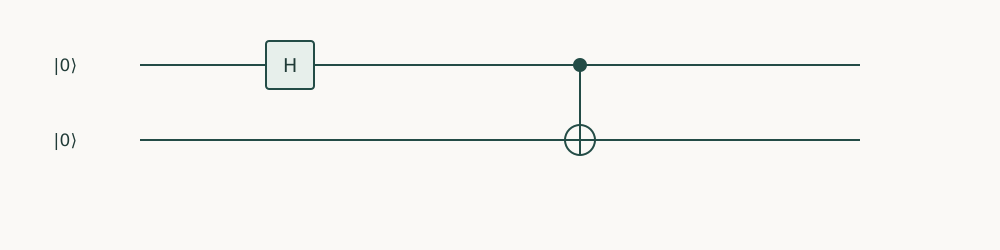
Now apply \(H\) to Alice and then CNOT, starting from \(\ket{00}\). After \(H\) the state is \((\ket{00}+\ket{10})/\sqrt2\). CNOT leaves the first term alone and sends the second to \(\ket{11}\):
Bell-pair preparation. A Hadamard followed by CNOT makes (|00⟩+|11⟩)/√2. The first wire is the control.
In a circuit, CNOT is a dot on the control wire joined by a vertical line to \(\oplus\) on the target. Could Alice and Bob have prepared \(\ket{\Phi^+}\) separately?
Problems
Problem 4.1. Can (|00〉+|01〉)/√2 be written as a state for Alice times a state for Bob?
Worked solution
Yes. It factors as |0〉⊗|+〉. Two nonzero joint amplitudes are not enough to rule out a product.
4.2 Entanglement
Every product state can be made by two people working apart. The circuit made \(\ket{\Phi^+}\) with a joint operation. Is it a product in disguise, or genuinely new? We first look at what the state keeps that a random choice of 00 or 11 would not: a definite relative phase, visible in a second basis. Then we prove that no product has its amplitudes, and turn the proof into a test that works for every pure two-qubit state.
The state \(\ket{\Phi^+}\) has amplitude \(1/\sqrt2\) on 00 and on 11, and zero on the unequal configurations. Measured in the computational basis, both qubits always agree. Is that all there is to it?
Compare the product \(\ket+\ket+=(\ket{00}+\ket{01}+\ket{10}+\ket{11})/2\). It gives all four outcomes equally often. So CNOT acting on plus with a zero target did not make two copies of plus. It copies 0 and 1, but on their superposition it produces something else.
What does \(\ket{\Phi^+}\) give in the plus/minus basis? Apply \(H\) to both qubits:
Adding and dividing by \(\sqrt2\), the unequal configurations cancel and \((H\otimes H)\ket{\Phi^+}=\ket{\Phi^+}\). So an X measurement on both qubits also gives equal results every time. Equivalently, \(\ket{\Phi^+}=(\ket{++}+\ket{--})/\sqrt2\). The cancellation needs the two terms to keep a fixed relative phase. A random choice between 00 and 11 would have nothing to cancel.
The relative phase can be changed. Applying \(Z\) to Alice gives \(\ket{\Phi^-}=(\ket{00}-\ket{11})/\sqrt2\), which has the same computational-basis counts but different plus/minus correlations. States of this family are called Bell states, after John Bell, and a pair of qubits in \(\ket{\Phi^+}\) is a Bell pair.
Could the Bell pair be a product \((a\ket0+b\ket1)\otimes(c\ket0+d\ket1)\)? Its amplitudes would require \(ac=bd=1/\sqrt2\) and \(ad=bc=0\). Nonzero \(ac\) and \(bd\) make all four of \(a,b,c,d\) nonzero. Then \(ad\) cannot vanish. No product works.
Can we turn this argument into a test for any pure two-qubit state? For a product, the amplitudes satisfy \(\alpha_{00}\alpha_{11}=ac\cdot bd=ad\cdot bc=\alpha_{01}\alpha_{10}\). So a product always has
The converse also holds. Arrange the amplitudes in two rows, \((\alpha_{00},\alpha_{01})\) for Alice's 0 and \((\alpha_{10},\alpha_{11})\) for her 1. When the expression above is zero, the two rows are proportional: both are multiples, \(a\) and \(b\), of one row \((c,d)\). Then the state is \(a\ket0(c\ket0+d\ket1)+b\ket1(c\ket0+d\ket1)\), a product. For the Bell pair the expression is \(1/2\), so it fails the test.
A pure joint state that is not a product is entangled. Entanglement is a statement about amplitudes. It says that no assignment of separate states to Alice and Bob reproduces the joint state. When preparations are mixed at random, deciding entanglement will need a broader definition.
Problems
Problem 4.2. What does Z on Alice do to the Bell pair?
Worked solution
It changes the sign of the 11 amplitude, producing (00−11)/√2. The computational-basis counts stay the same, but plus/minus correlations change.
4.3 Joint Measurement
The definition of entanglement used amplitudes, which nobody sees directly. What do Alice and Bob observe when they measure an entangled pair? We sum joint probabilities to get what each sees alone and condition on the other's record, which also explains the lost interference. Then we compare the Bell pair with a random mixture of 00 and 11, and find the measurement that tells them apart.
If both qubits of a joint state are measured in the computational basis, the outcome \(xy\) has probability \(|\alpha_{xy}|^2\). For the Bell pair, 00 and 11 each occur with probability \(1/2\). What does Alice see if she ignores Bob?
As with the noisy wire, we add the joint probabilities over Bob's outcomes. Alice reads 0 with probability \(1/2+0=1/2\), and 1 with probability \(1/2\). Bob's marginal is the same. Each half alone looks like a fair coin. Conditional on Alice reading 0, though, Bob reads 0 with certainty. That conditional prediction is useful only to someone who knows Alice's record. Bob, on his own, cannot sort his trials into her two groups.
Now we can explain the path record. A photon passes the first beam splitter, so its path state is \(\ket+\). A recorder starts in \(\ket0\), and a CNOT from the path to the recorder writes the path into it. The pair is now in \(\ket{\Phi^+}\). The second beam splitter applies \(H\) to the photon only:
The photon's marginal probability for detector 0 is \(1/4+1/4=1/2\). The interference is gone. Why? Without a record, the two contributions to detector 0 arrived in the same joint configuration and added. With a record, they arrive with different recorder labels, 00 and 01. Amplitudes add only within one joint configuration, so the contributions can no longer cancel or reinforce.
Suppose a source flips a fair coin and prepares \(\ket{00}\) or \(\ket{11}\) accordingly. Its computational-basis results agree perfectly, exactly like the Bell pair's. Do perfect correlations in one basis show that a pair is entangled?
Measure in the plus/minus basis. Expanding each product state there gives
For the random source, each trial is one product state or the other, never both. Each gives all four plus/minus outcomes with probability \(1/4\), and averaging probabilities over trials leaves \(1/4\) each. Nothing cancels, because the terms belong to separate trials. For the Bell pair the two expansions add in one state, the unequal outcomes cancel, and only \(++\) and \(--\) occur.
So correlations in one basis do not establish entanglement. The second basis reveals the relative phase that the random source lacks. Neither Alice nor Bob can see the difference alone: in both constructions, each local histogram is fair in either basis. Only the joint statistics differ.
We now have two quite different objects that agree on many predictions: a random choice between pure states, and one half of an entangled pair. A single vector describes neither. What description does?
Problems
Problem 4.3. Can Bob tell from his local counts whether Alice measured her Bell half?
Worked solution
Not without a record selecting her outcome. His unconditioned local distribution remains fair. The general no-signalling argument comes once operations and measurements are described in full.
Transfer problem. For \(\ket{\Phi^-}=(\ket{00}-\ket{11})/\sqrt2\), compute the plus/minus joint distribution and each local marginal.
Worked solution
Expanding in the new basis gives \((\ket{+-}+\ket{-+})/\sqrt2\). The two unequal outcomes each have probability one half; equal outcomes have probability zero. Each local marginal is still fair. A relative sign has changed joint correlations without changing either marginal.
Summary
The joint Hilbert space of composite systems \(A\) and \(B\) is the tensor product \(\mathcal{H}_A \otimes \mathcal{H}_B\), whose dimension grows multiplicatively as \(d_A d_B\).
Product states \(|\psi\rangle_A \otimes |\phi\rangle_B\) exhibit independent local statistics, whereas entangled states such as the Bell basis cannot be factored into separate subsystem state vectors.
Every bipartite pure state admits a Schmidt decomposition \(|\Psi\rangle_{AB} = \sum_i \sqrt{\lambda_i}|u_i\rangle_A|v_i\rangle_B\), whose positive Schmidt coefficients \(\lambda_i\) completely characterize its bipartite entanglement.
Questions and worked problems
These exercises draw on the whole chapter. Attempt each question before opening a hint, explain your reasoning, then compare it with the worked solution.
Use the test \(\alpha_{00}\alpha_{11}-\alpha_{01}\alpha_{10}=0\) to classify (a) \(\frac12(\ket{00}+\ket{01}-\ket{10}-\ket{11})\) and (b) \(\frac12(\sqrt3\ket{00}+\ket{11})\). Factor the product state.
Hint 1
For (a), compute \((1)(-1)-(1)(-1)\), up to the common factor.
Hint 2
Try \(\ket-\otimes\ket+\) for (a).
Worked solution
(a) \(\frac14\big[(1)(-1)-(1)(-1)\big]=0\): a product. Indeed \(\ket-\otimes\ket+=\frac12(\ket0-\ket1)(\ket0+\ket1)=\frac12(\ket{00}+\ket{01}-\ket{10}-\ket{11})\). (b) \(\frac{\sqrt3}{4}-0\neq0\): entangled, although one outcome dominates. Entanglement is a yes-or-no property of whether the amplitudes factor; how much entanglement a state has is a separate question, answered by its Schmidt coefficients.
Starting from \(\ket{01}\), apply \(H\) to Alice and then CNOT from Alice to Bob. Which state results? What are the computational-basis joint probabilities?
\(H\otimes I\) gives \(\frac{1}{\sqrt2}(\ket{01}+\ket{11})\), and CNOT sends \(\ket{11}\) to \(\ket{10}\), giving \(\ket{\Psi^+}=\frac{1}{\sqrt2}(\ket{01}+\ket{10})\). The outcomes \(01\) and \(10\) each have probability \(\frac12\): the bits are always opposite. The same circuit prepares a different Bell state from each of the four basis inputs.
For \(\ket\Psi=\frac{1}{\sqrt3}(\ket{00}+\ket{01}+\ket{11})\), find Alice’s and Bob’s marginal probabilities of \(0\), and Bob’s conditional state after Alice obtains \(0\) and after she obtains \(1\).
Hint 1
Sum the joint probabilities over the other party’s bit.
Hint 2
Keep the terms with Alice’s observed bit and renormalize.
Worked solution
Each configuration has probability \(\frac13\). Alice gets \(0\) with probability \(\frac23\) (from \(00,01\)); Bob gets \(0\) with probability \(\frac13\) (from \(00\) only). After Alice obtains \(0\), Bob holds \(\frac{1}{\sqrt2}(\ket0+\ket1)=\ket+\); after she obtains \(1\), he holds \(\ket1\). His conditional state depends on her result, which is another sign that the joint state is entangled.
Alice measures her half of \(\ket{\Phi^+}\) in the computational basis, and Bob measures his in the \(\pm\) basis. (a) Write \((I\otimes H)\ket{\Phi^+}\) and find the four joint probabilities. (b) Are the results correlated? (c) Compare with both measuring in the same basis.
(a) \((I\otimes H)\ket{\Phi^+}=\frac{1}{\sqrt2}(\ket0\ket++\ket1\ket-)=\frac12(\ket{00}+\ket{01}+\ket{10}-\ket{11})\), so each of the four pairs has probability \(\frac14\). (b) No: Alice’s result tells Bob nothing about his \(\pm\) result. (c) When both use the computational basis, or both the \(\pm\) basis, the results always agree. The Bell pair is perfectly correlated for matching bases and uncorrelated for these mismatched ones. That basis dependence is what quantum key distribution exploits.
The four Bell states are \(\ket{\Phi^\pm}=\frac{1}{\sqrt2}(\ket{00}\pm\ket{11})\) and \(\ket{\Psi^\pm}=\frac{1}{\sqrt2}(\ket{01}\pm\ket{10})\). (a) Show that Alice can turn \(\ket{\Phi^+}\) into each of the others with \(Z\), \(X\), or \(XZ\) on her qubit. (b) Show that CNOT from Alice to Bob followed by \(H\) on Alice maps \(\ket{\Phi^+},\ket{\Psi^+},\ket{\Phi^-},\ket{\Psi^-}\) to \(\ket{00},\ket{01},\ket{10},\ket{11}\).
Hint 1
For (b), CNOT turns \(\ket{\Phi^-}\) into \(\ket-\ket0\).
Hint 2
\(H\ket-=\ket1\).
Worked solution
(a) \(Z\) on Alice gives \(\ket{\Phi^-}\); \(X\) gives \(\frac{1}{\sqrt2}(\ket{10}+\ket{01})=\ket{\Psi^+}\); \(XZ\) (apply \(Z\), then \(X\)) gives \(\frac{1}{\sqrt2}(\ket{10}-\ket{01})=-\ket{\Psi^-}\). (b) CNOT maps \(\ket{\Phi^\pm}\) to \(\ket\pm\ket0\) and \(\ket{\Psi^\pm}\) to \(\ket\pm\ket1\); then \(H\) on Alice maps \(\ket+\to\ket0\) and \(\ket-\to\ket1\). So \(\ket{\Phi^+}\to\ket{00}\), \(\ket{\Psi^+}\to\ket{01}\), \(\ket{\Phi^-}\to\ket{10}\), \(\ket{\Psi^-}\to\ket{11}\). The four Bell states are orthogonal and this circuit distinguishes them perfectly: a Bell measurement. Combined with part (a), it lets Alice’s local choice be read by a joint measurement, the idea behind dense coding.
Prove the converse of the product test: if \(\alpha_{00}\alpha_{11}=\alpha_{01}\alpha_{10}\) and \(\alpha_{00}\neq0\), then the state factors. Write the factors explicitly, and apply the construction to \(\frac12(\ket{00}+i\ket{01}+\ket{10}+i\ket{11})\).
Use \(\alpha_{11}=\alpha_{01}\alpha_{10}/\alpha_{00}\).
Worked solution
Expand \((\alpha_{00}\ket0+\alpha_{10}\ket1)\otimes(\ket0+\frac{\alpha_{01}}{\alpha_{00}}\ket1)\): the coefficients are \(\alpha_{00}\), \(\alpha_{01}\), \(\alpha_{10}\), and \(\alpha_{10}\alpha_{01}/\alpha_{00}=\alpha_{11}\), using the hypothesis. So the state is a product of two (unnormalized) vectors; rescaling one and dividing the other by the same factor makes both unit vectors. (If \(\alpha_{00}=0\), start from another nonzero coefficient.) For the example, \(\alpha_{00}\alpha_{11}=\frac i4=\alpha_{01}\alpha_{10}\), and the construction gives \(\frac12(\ket0+\ket1)\otimes(\ket0+i\ket1)=\ket+\otimes\frac{\ket0+i\ket1}{\sqrt2}\).
Consider \(\ket{\psi_\theta}=\cos\theta\ket{00}+\sin\theta\ket{11}\). Both parties measure in the \(\pm\) basis. Using \(\ket{00}=\frac12(\ket{++}+\ket{+-}+\ket{-+}+\ket{--})\) and \(\ket{11}=\frac12(\ket{++}-\ket{+-}-\ket{-+}+\ket{--})\), find the probability that their results agree. Evaluate at \(\theta=0\), \(\pi/8\), and \(\pi/4\).
Hint 1
The amplitude of \(\ket{++}\) and of \(\ket{--}\) is \(\frac12(\cos\theta+\sin\theta)\).
Hint 2
\((\cos\theta+\sin\theta)^2=1+\sin2\theta\).
Worked solution
Collecting terms, \(\ket{\psi_\theta}=\frac{\cos\theta+\sin\theta}{2}(\ket{++}+\ket{--})+\frac{\cos\theta-\sin\theta}{2}(\ket{+-}+\ket{-+})\). The probability of agreement is \(2\cdot\frac{(\cos\theta+\sin\theta)^2}{4}=\frac12(1+\sin2\theta)\). At \(\theta=0\) (the product \(\ket{00}\)) it is \(\frac12\): no correlation. At \(\theta=\pi/8\) it is about \(0.854\). At \(\theta=\pi/4\) (the Bell state) it is \(1\). In the computational basis the bits agree for every \(\theta\); the \(\pm\) correlation reveals how much coherent superposition the joint state contains.
A student says: “If all four computational-basis outcomes of a two-qubit state are equally likely, the two qubits must be independent, so the state is a product.” Test the claim on \(\frac12(\ket{00}+\ket{01}+\ket{10}-\ket{11})\).
Hint 1
Apply the product test.
Hint 2
Equal probabilities say nothing about the relative signs.
Worked solution
The probabilities are all \(\frac14\), and indeed the computational-basis outcomes are independent. But \(\alpha_{00}\alpha_{11}-\alpha_{01}\alpha_{10}=\frac14(-1-1)=-\frac12\neq0\), so the state is entangled. In fact it is \(\frac{1}{\sqrt2}(\ket0\ket++\ket1\ket-)\): if Alice measures in the computational basis, Bob’s qubit is \(\ket+\) or \(\ket-\), perfectly correlated with her result in his \(\pm\) basis. Independence of outcomes in one pair of bases does not imply a product state; the signs of the amplitudes carry the correlation into other bases.
Write any two-qubit state as \(\ket0\otimes\ket a+\ket1\otimes\ket b\), where \(\ket a=\alpha_{00}\ket0+\alpha_{01}\ket1\) and \(\ket b=\alpha_{10}\ket0+\alpha_{11}\ket1\) need not be normalized. (a) Show that the state is a product exactly when \(\ket a\) and \(\ket b\) are parallel (one is a multiple of the other, or one is zero). (b) Relate this to Bob’s conditional states after Alice measures. (c) Show that \(\alpha_{00}\alpha_{11}-\alpha_{01}\alpha_{10}=0\) is the condition for \(\ket a\) and \(\ket b\) to be parallel.
Hint 1
If \(\ket b=c\ket a\), factor out \(\ket a\).
Hint 2
Two vectors in two dimensions are parallel when the determinant of their coordinates vanishes.
Worked solution
(a) If \(\ket b=c\ket a\), the state is \((\ket0+c\ket1)\otimes\ket a\), a product. Conversely, a product \((p\ket0+q\ket1)\otimes\ket\phi\) gives \(\ket a=p\ket\phi\) and \(\ket b=q\ket\phi\), which are parallel. (b) After Alice obtains \(0\) or \(1\), Bob holds \(\ket a\) or \(\ket b\), normalized. So the state is a product exactly when Bob’s conditional state is the same (up to phase) for both of Alice’s outcomes. (c) The coordinate vectors \((\alpha_{00},\alpha_{01})\) and \((\alpha_{10},\alpha_{11})\) are parallel exactly when \(\alpha_{00}\alpha_{11}-\alpha_{01}\alpha_{10}=0\). Entanglement means that Alice’s measurement leaves Bob with genuinely different states.
Arrange the amplitudes in the matrix \(C=\begin{pmatrix}\alpha_{00}&\alpha_{01}\\\alpha_{10}&\alpha_{11}\end{pmatrix}\). Show that a local operation \(U\otimes V\) changes \(C\) to \(UCV^T\), and conclude that \(|\det C|=|\alpha_{00}\alpha_{11}-\alpha_{01}\alpha_{10}|\) is unchanged by local unitaries. Evaluate it for a product state and for a Bell state. What does this imply about creating entanglement locally?
\(\det(UCV^T)=\det U\det C\det V\), and a unitary has \(|\det|=1\).
Worked solution
Since \((U\otimes V)\sum_{ij}\alpha_{ij}\ket{ij}=\sum_{kl}\big(\sum_{ij}U_{ki}\alpha_{ij}V_{lj}\big)\ket{kl}\), the new coefficient matrix is \(UCV^T\). Then \(|\det(UCV^T)|=|\det U|\,|\det C|\,|\det V|=|\det C|\), because a unitary’s determinant has magnitude \(1\). A product state has \(\det C=0\); a Bell state has \(|\det C|=\frac12\), the largest possible for a normalized state. Local unitaries therefore cannot turn a product into an entangled state or reduce a Bell state to a product: creating or destroying entanglement needs a joint operation such as CNOT. (Twice this quantity is the concurrence of a pure state.)