Starting point: Marginal probabilities, the inner product and joint states; density operators are constructed from averaged measurement probabilities.
Keep in view: Compare a random choice of basis states with one half of a Bell pair.
We can describe pairs of qubits, and we have found that some pairs are entangled: no separate states for Alice and Bob reproduce their joint amplitudes. We also met two objects that a single vector cannot describe. One is a qubit prepared by a coin toss. The other is one half of a Bell pair.
Both give fair results in every basis, yet their histories are completely different. What description predicts every test on such a system, and no more? Averaging test probabilities over a random preparation leads to one matrix, the density operator. Summing joint probabilities over an unobserved partner leads to the same kind of matrix, the reduced state. The two constructions can give identical matrices, so a density operator does not record how it was prepared. Reversing the second construction shows that every mixed state can be viewed as part of a larger pure state.
5.1 Uncertain Preparations
A coin decides which state a device prepares, and nobody tells the receiver the result. How should the receiver predict a test? We first average the test probabilities over the coin and see that the result differs from any superposition. Then we look for the smallest object that still gives every such average, and find it in a matrix.
A device flips a fair coin and prepares \(\ket0\) on heads and \(\ket1\) on tails. Is the result the same as preparing \(\ket+\), which also gives 0 and 1 equally often?
A Z measurement cannot tell: both give fair results. Try an X measurement. On \(\ket+\) it gives plus with certainty. On the coin's output, each trial is \(\ket0\) or \(\ket1\), and each of those passes the plus test with probability \(|\braket+0|^2=|\braket+1|^2=1/2\). Averaging over the coin gives \(1/2\). So the two preparations differ.
The general rule follows the same steps. A device that prepares \(\ket{\psi_j}\) with probability \(p_j\) defines an ensemble. The probability that its output passes a test for \(\ket\phi\) is the average of the separate probabilities,
This averages probabilities over trials. A superposition instead adds amplitudes within each trial and then squares. That is why plus can interfere in the X measurement and the coin's output cannot.
The rule raises a practical question. Must we carry the whole list of states and probabilities to make predictions? Two different lists might give the same prediction for every test. If so, the list holds more than any measurement on the system can reveal.
What part of the ensemble does a test probability actually use? Rewrite one term. A squared magnitude is a number times its conjugate, and the conjugate of \(\braket\phi\psi\) is \(\braket\psi\phi\). So
The matrix \(\rho\) is the density operator, or density matrix, of the ensemble. It is all we need for every test, so two ensembles with the same \(\rho\) can never be told apart by measuring the system.
Compare our two preparations. Plus has \(\rho=\tfrac12\begin{pmatrix}1&1\\1&1\end{pmatrix}\). The coin mixture has \(\tfrac12(\ket0\bra0+\ket1\bra1)=I/2\). The diagonal entries are the Z-measurement probabilities, and they agree. The off-diagonal entries differ. The plus test computes \(\bra+\rho\ket+\), which is half the sum of all four entries: 1 for plus, \(1/2\) for the mixture. The off-diagonal entries carry the relative phase that interference needs. They are often called coherences.
Which matrices can be density operators? Two conditions follow from what \(\rho\) predicts. Every test probability is nonnegative, so \(\bra v\rho\ket v\geq0\) for every vector \(v\). A matrix with this property is positive. The outcomes of a basis measurement exhaust the possibilities, so their probabilities \(\bra k\rho\ket k\) add to one. That sum is the sum of the diagonal entries, called the trace, \(\mathrm{tr}\,\rho\). Its value does not depend on the basis, because each outer product \(\ket\psi\bra\psi\) contributes \(\sum_k|\braket k\psi|^2=1\) in any basis. So a density operator is positive with trace one.
The matrix also mirrors itself: the entry \(a^*b\) is the conjugate of \(ab^*\). A matrix equal to its own adjoint, \(\rho^\dagger=\rho\), is called Hermitian. A state whose density operator is a single outer product is pure, as before. Any other density operator describes a mixed state.
Problems
Problem 5.1. Compute the density matrix of plus.
Worked solution
It is \(\frac12\begin{pmatrix}1&1\\1&1\end{pmatrix}\). The off-diagonal entries distinguish it from I/2.
5.2 Subsystems
The second object was one half of a Bell pair. Nothing random chose its state; the pair as a whole is pure. Which matrix predicts tests that Alice makes on her half alone? We derive it from the joint state by summing over Bob's labels, which defines the partial trace. Then we compare what the reduced state keeps with what only the joint state knows.
Alice tests her half of \(\ket{\Phi^+}\) for a state \(\ket\phi=\phi_0\ket0+\phi_1\ket1\). Bob does nothing. What is the probability that she passes?
In the joint description, "Alice passes" includes every possible Bob label. It is the projector onto the two orthogonal directions \(\ket{\phi,0}\) and \(\ket{\phi,1}\). By the measurement postulate its probability is the sum of the two squared amplitudes, just as a marginal sums a joint table:
The answer is \(1/2\) for every \(\phi\). Which single-qubit matrix gives \(1/2\) for every test? Only \(I/2\). So Alice's half behaves exactly like the coin mixture of 0 and 1.
Now do the same for any joint state \(\ket\Psi=\sum_{a,b}\alpha_{ab}\ket{ab}\). The amplitude to find \(\phi\) on Alice's side and \(b\) on Bob's is \(\sum_a\phi_a^*\alpha_{ab}\). Squaring and adding over \(b\),
In terms of the joint density matrix, \((\rho_A)_{aa'}=\sum_b(\rho_{AB})_{ab,a'b}\): keep the entries whose Bob labels match on both sides, and add over that label. This is the partial trace over Bob, written \(\rho_A=\mathrm{tr}_B\,\rho_{AB}\). The result is Alice's reduced state. By construction it gives the same prediction as the joint state for every Alice-only test. For a mixed joint state the same formula holds, because both sides are averages of the pure-state case.
Alice's 0 probability adds the 00 and 01 diagonal entries, giving \(1/2\). Her 1 probability adds the 10 and 11 entries. Her off-diagonal entry adds \(\rho_{00,10}+\rho_{01,11}\), both zero. The large corner entries belong to \(\ket{00}\bra{11}\), whose Bob labels differ, so the partial trace never collects them. The result is \(I/2\).
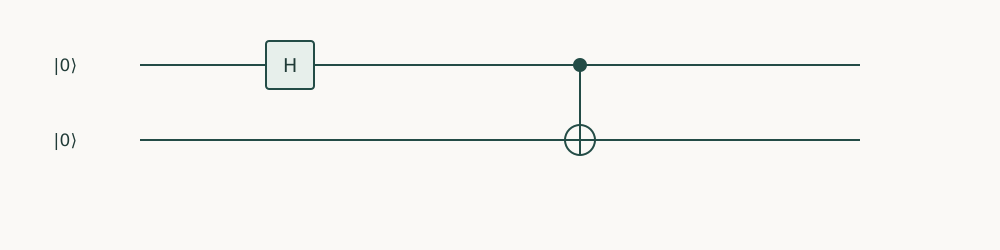
Bell-pair preparation. A Hadamard followed by CNOT makes (|00⟩+|11⟩)/√2. The first wire is the control.
So the Bell pair is pure as a whole and mixed in each part. Does Alice's local uncertainty mean that some hidden pure state was secretly chosen for her qubit? Nothing in the construction chose one. The randomness of her results comes from the entanglement, not from a coin.
What does the reduced state miss? Compare the Bell pair with the equal mixture of \(\ket{00}\) and \(\ket{11}\), whose joint matrix is \(\tfrac12(\ket{00}\bra{00}+\ket{11}\bra{11})\). Both have reduced states \(I/2\) on each side. Yet their joint matrices differ in the corner coherences, and the X-measurement correlations showed that difference. A reduced state is complete for one party's predictions. Correlations between the parties need the joint state.
Problems
Problem 5.2. Why does tracing out Bob kill |00〉〈11|?
Worked solution
The partial trace sums terms with the same Bob index on the ket and bra. Here those indices are zero and one, whose overlap is zero.
5.3 Equivalent Descriptions
A coin mixture and a Bell half gave the same matrix \(I/2\). How many different preparations can hide behind one density operator? We first find two different ensembles with the same matrix. Then we reverse the partial trace: for any mixed state we build a pure joint state whose part it is. Its freedom explains where the different ensembles come from.
Suppose a coin now chooses between \(\ket+\) and \(\ket-\). Is that a different source from the coin choosing \(\ket0\) or \(\ket1\)? Compute its matrix:
The off-diagonal entries cancel. Both sources have the density operator \(I/2\). Since every test probability depends only on \(\rho\), no measurement on the qubit alone can reveal which coin procedure was used.
The procedures are still different physical histories. Someone holding the coin's record could tell them apart. That knowledge lives in the record, not in the qubit. So a density operator generally has many ensemble decompositions, and it does not say which one, if any, took place.
The Bell half was mixed but came from a pure pair. Can every mixed state be viewed that way? Try \(\rho=\tfrac34\ket0\bra0+\tfrac14\ket1\bra1\). Add an auxiliary qubit and prepare
The partial trace over the auxiliary gives diagonal entries \(3/4\) and \(1/4\). The off-diagonal entry is \(\alpha_{00}\alpha_{10}^*+\alpha_{01}\alpha_{11}^*=0\), because each term pairs different auxiliary labels. So the reduced state is exactly \(\rho\). A pure joint state whose reduced state is \(\rho\) is a purification of \(\rho\).
The same construction works for any ensemble. Give each member its own orthogonal label in an auxiliary system \(E\):
Tracing out \(E\) keeps only terms with matching labels, and \(\braket jk=0\) for \(j\neq k\). What remains is \(\sum_jp_j\ket{\psi_j}\bra{\psi_j}=\rho\). A purification is a mathematical representation. It does not claim that anyone holds or controls the purifying system, and the system alone stays mixed.
How unique is a purification? Apply any unitary to \(E\) alone. The labels \(\ket j\) become another orthonormal set, the cross terms still vanish, and the reduced state is unchanged. But measuring \(E\) in different bases leaves the system in different ensembles. The Bell pair shows this. If Bob measures Z, Alice is left with \(\ket0\) or \(\ket1\), each with probability \(1/2\). If he measures X, then since \(\ket{\Phi^+}=(\ket{++}+\ket{--})/\sqrt2\) she is left with \(\ket+\) or \(\ket-\). Both ensembles of \(I/2\) come from one purification, read in two ways.
So far a system has either evolved alone, by a unitary, or been described as part of something larger. What happens to a qubit that interacts with another system which is then discarded?
Problems
Problem 5.3. Can the density matrix identify a unique preparation ensemble?
Worked solution
No. Different ensembles can give identical matrices and hence identical predictions for every measurement on the system alone.
Transfer problem. Find the matrix for an equal mixture of zero and plus. Can it equal a pure state with 0/1 probabilities 3/4 and 1/4?
Worked solution
The mixture is \(\begin{pmatrix}3/4&1/4\\1/4&1/4\end{pmatrix}\), with determinant 1/8. For a two-by-two matrix with rows (a,b) and (c,d), its determinant is ad−bc. A pure state’s outer product has determinant zero: its off-diagonal magnitude here would be \(\sqrt3/4\), not 1/4. Matching its diagonal probabilities does not match the density matrix.
Summary
A density operator \(\rho = \sum_j p_j |\psi_j\rangle\langle\psi_j|\) is a positive semidefinite operator of trace one that captures both classical ensemble uncertainty and entanglement with unobserved subsystems.
Every expectation value and measurement probability depends only on \(\rho\) via \(\langle M\rangle = \mathrm{Tr}(\rho M)\), so distinct ensembles with the same density matrix are operationally indistinguishable.
The partial trace \(\rho_A = \mathrm{Tr}_B(\rho_{AB})\) is the unique operation that reproduces all local measurement statistics on subsystem \(A\) alone.
Questions and worked problems
These exercises draw on the whole chapter. Attempt each question before opening a hint, explain your reasoning, then compare it with the worked solution.
Write the density matrix of \(\ket{y_+}=(\ket0+i\ket1)/\sqrt2\). Which entries distinguish it from \(\ket+\bra+\) and from \(I/2\)?
Hint 1
Use \(\ket\psi\bra\psi=\begin{pmatrix}|a|^2&ab^*\\a^*b&|b|^2\end{pmatrix}\).
Hint 2
Here \(a=1/\sqrt2\) and \(b=i/\sqrt2\).
Worked solution
\(\ket{y_+}\bra{y_+}=\begin{pmatrix}\frac12&-\frac i2\\\frac i2&\frac12\end{pmatrix}\). All three matrices have diagonal \((\frac12,\frac12)\), so they give identical computational-basis statistics. The off-diagonal entries differ: \(\frac12\) for \(\ket+\), \(\mp\frac i2\) for \(\ket{y_+}\), and \(0\) for \(I/2\). These coherences carry the relative phase, and they are what a \(\pm\) test or a test along \(\ket{y_+}\) detects.
A \(2\times2\) Hermitian matrix with trace \(1\) is a valid density matrix exactly when its determinant is nonnegative. Which of these are valid? (a) \(\begin{pmatrix}0.7&0.5\\0.5&0.3\end{pmatrix}\); (b) \(\begin{pmatrix}0.5&0.5\\0.5&0.5\end{pmatrix}\); (c) \(\begin{pmatrix}0.8&0.2i\\-0.2i&0.2\end{pmatrix}\).
Hint 1
For trace \(1\), the eigenvalues are \(\lambda\) and \(1-\lambda\), with product \(\det\rho\).
Hint 2
Both eigenvalues must be nonnegative.
Worked solution
(a) \(\det=0.21-0.25=-0.04<0\): one eigenvalue is negative, so a test along the corresponding direction would have negative probability. Not valid. (b) \(\det=0\): valid, and pure, since it is \(\ket+\bra+\). (c) \(\det=0.16-0.04=0.12>0\): valid, and mixed. The off-diagonal entries of a density matrix are limited by its diagonal: \(|\rho_{01}|^2\le\rho_{00}\rho_{11}\). Coherence cannot exceed what the populations allow.
The purity \(\mathrm{tr}(\rho^2)\) equals \(1\) for pure states and is smaller for mixed ones. Compute it for \(\ket+\bra+\), \(I/2\), and \(\mathrm{diag}(\frac34,\frac14)\).
Hint 1
For a diagonal matrix, \(\mathrm{tr}\rho^2\) is the sum of the squared diagonal entries.
Hint 2
\(\ket\psi\bra\psi\) squared is itself.
Worked solution
For a pure state, \((\ket\psi\bra\psi)^2=\ket\psi\braket\psi\psi\bra\psi=\ket\psi\bra\psi\), so the purity is \(1\). For \(I/2\), \(\frac14+\frac14=\frac12\), the smallest possible for a qubit. For \(\mathrm{diag}(\frac34,\frac14)\), \(\frac{9}{16}+\frac{1}{16}=\frac58\). Purity measures how far a state is from maximally mixed, independently of which ensemble produced it.
Find Alice’s reduced density matrix for \(\ket\Psi=\frac{1}{\sqrt3}(\ket{00}+\ket{01}+\ket{11})\), including its off-diagonal entry. Is her state pure? Compute its purity.
The off-diagonal entry pairs terms with the same Bob label: only \(b=1\) contributes.
Worked solution
\((\rho_A)_{00}=|\alpha_{00}|^2+|\alpha_{01}|^2=\frac23\) and \((\rho_A)_{11}=|\alpha_{10}|^2+|\alpha_{11}|^2=\frac13\). The coherence is \((\rho_A)_{01}=\alpha_{00}\alpha_{10}^*+\alpha_{01}\alpha_{11}^*=0+\frac13=\frac13\). So \(\rho_A=\begin{pmatrix}\frac23&\frac13\\\frac13&\frac13\end{pmatrix}\). Its purity is \(\frac49+\frac19+2\cdot\frac19=\frac79<1\), so Alice’s state is mixed, as it must be for an entangled pure state. It still has coherence, unlike the Bell-pair reduction \(I/2\).
Let \(\ket{\psi_k}=\cos\frac{2\pi k}{3}\ket0+\sin\frac{2\pi k}{3}\ket1\) for \(k=0,1,2\): three real states at \(120^\circ\) from one another. Show that choosing each with probability \(\frac13\) gives \(\rho=I/2\). Name two other ensembles with the same density matrix.
Hint 1
Compute \(\sum_k\cos^2\), \(\sum_k\sin^2\), and \(\sum_k\cos\sin\) over the three angles \(0,120^\circ,240^\circ\).
Hint 2
\(\cos^2\) values: \(1,\frac14,\frac14\).
Worked solution
The diagonal entries of \(\frac13\sum_k\ket{\psi_k}\bra{\psi_k}\) are \(\frac13\sum\cos^2=\frac13(1+\frac14+\frac14)=\frac12\) and \(\frac13\sum\sin^2=\frac13(0+\frac34+\frac34)=\frac12\). The off-diagonal entry is \(\frac13\sum\cos\sin=\frac13\big(0-\frac{\sqrt3}{4}+\frac{\sqrt3}{4}\big)=0\). So \(\rho=I/2\). The same matrix arises from \(\{\ket0,\ket1\}\) with equal weights and from \(\{\ket+,\ket-\}\) with equal weights, and also as half of a Bell pair. No measurement on the qubit alone can tell these preparations apart.
For the equal mixture of \(\ket0\) and \(\ket+\), \(\rho=\begin{pmatrix}\frac34&\frac14\\\frac14&\frac14\end{pmatrix}\). (a) Find its eigenvalues. (b) Check that \(\ket{v_1}=\cos\frac\pi8\ket0+\sin\frac\pi8\ket1\) is an eigenvector. (c) Write \(\rho\) as a mixture of two orthogonal states, and give a purification.
Hint 1
For trace \(1\), the eigenvalues are \(\frac12(1\pm\sqrt{1-4\det\rho})\).
Hint 2
\(\det\rho=\frac{3}{16}-\frac{1}{16}=\frac18\).
Worked solution
(a) \(\lambda_\pm=\frac12\big(1\pm\sqrt{1-\frac12}\big)=\frac12\pm\frac{\sqrt2}{4}\approx0.854,\ 0.146\). (b) Writing \(c=\cos\frac\pi8\), \(s=\sin\frac\pi8\), \(\rho\ket{v_1}=(\frac34c+\frac14s,\ \frac14c+\frac14s)\); using \(s/c=\tan\frac\pi8=\sqrt2-1\), both components equal \(\lambda_+\) times \((c,s)\). (c) \(\rho=\lambda_+\ket{v_1}\bra{v_1}+\lambda_-\ket{v_2}\bra{v_2}\) with \(\ket{v_2}=-s\ket0+c\ket1\). A purification is \(\sqrt{\lambda_+}\ket{v_1}\ket0+\sqrt{\lambda_-}\ket{v_2}\ket1\). The same mixed state arises from two nonorthogonal states with equal weights, or from two orthogonal states with unequal weights.
Alice and Bob share \(\ket\Psi=\frac{1}{\sqrt2}(\ket0_A\ket0_B+\ket1_A\ket+_B)\). (a) Find Bob’s reduced density matrix. (b) Identify an ensemble that gives the same matrix. (c) What does Alice’s computational-basis measurement do to Bob’s state, and why does it not change his local predictions?
Hint 1
Alice’s labels are orthogonal, so the cross terms vanish when she is discarded.
Hint 2
Compare with the equal mixture of \(\ket0\) and \(\ket+\).
Worked solution
(a) Tracing out Alice, whose labels \(\ket0,\ket1\) are orthogonal, removes the cross terms: \(\rho_B=\frac12\ket0\bra0+\frac12\ket+\bra+=\begin{pmatrix}\frac34&\frac14\\\frac14&\frac14\end{pmatrix}\). (b) That is the equal mixture of \(\ket0\) and \(\ket+\), so \(\ket\Psi\) purifies it, with Alice’s qubit holding the preparation record. (c) If Alice measures, Bob is left with \(\ket0\) or \(\ket+\), each with probability \(\frac12\); averaged over her unreported outcomes, his density matrix is unchanged. Her record sorts his trials into two groups but does not change his overall statistics.
A student reads \(\rho=I/2\) as: “the qubit is really in \(\ket0\) or \(\ket1\), we just don’t know which.” Give two physical preparations that produce the same \(\rho\) but make this statement false or meaningless, and explain why no measurement on the qubit can support it.
Hint 1
Consider an equal mixture of \(\ket+\) and \(\ket-\).
Hint 2
Consider half of a Bell pair.
Worked solution
An equal mixture of \(\ket+\) and \(\ket-\) gives \(I/2\), and in each run the qubit was prepared in a state that is neither \(\ket0\) nor \(\ket1\). Half of \(\ket{\Phi^+}\) also gives \(I/2\), yet the global state is pure and no run selects a local pure state at all. Since every local measurement depends only on \(\rho\), no experiment on the qubit can reveal which story is true. A density matrix specifies all local predictions, not a hidden preferred list of pure states; any interpretation as ignorance of a particular ensemble needs information from outside the system.
Alice and Bob share \(\ket{\Phi^+}\). (a) If Alice measures in the computational basis, which states does Bob hold, with what probabilities? (b) Repeat for the \(\pm\) basis, using \(\ket{\Phi^+}=\frac{1}{\sqrt2}(\ket{++}+\ket{--})\). (c) Show that both ensembles give Bob the same density matrix, and explain why Alice’s choice of basis cannot send Bob a message.
Hint 1
Each of Alice’s outcomes leaves Bob with the matching state.
Hint 2
Compare \(\frac12(\ket0\bra0+\ket1\bra1)\) with \(\frac12(\ket+\bra++\ket-\bra-)\).
Worked solution
(a) Bob holds \(\ket0\) or \(\ket1\), each with probability \(\frac12\). (b) Bob holds \(\ket+\) or \(\ket-\), each with probability \(\frac12\). (c) Both ensembles average to \(I/2\). Alice’s choice of basis selects which ensemble describes Bob’s conditional states, but without her outcomes he cannot sort his trials, and every one of his measurements depends only on \(\rho_B=I/2\). This freedom to steer the ensemble without changing the density matrix is the purification freedom of Section 5.3.2 in action, and it is why entanglement alone does not signal.
For the pure two-qubit state \(\cos\theta\ket{00}+\sin\theta\ket{11}\), show that Alice’s reduced state is \(\mathrm{diag}(\cos^2\theta,\sin^2\theta)\) and that its purity is \(1-\frac12\sin^22\theta\). For which \(\theta\) is it pure, and for which is it maximally mixed? What does this suggest about using local mixedness to measure the entanglement of pure states?
Hint 1
The off-diagonal entry pairs terms with equal Bob labels; there are none.
The reduced state has diagonal \((\cos^2\theta,\sin^2\theta)\) and zero coherence, because the two terms carry different Bob labels. Its purity is \(\cos^4\theta+\sin^4\theta=1-2\cos^2\theta\sin^2\theta=1-\frac12\sin^22\theta\). It equals \(1\) (pure) only when \(\sin2\theta=0\), that is, for the product states \(\ket{00}\) and \(\ket{11}\), and is smallest, \(\frac12\), at \(\theta=\pi/4\), the Bell state. For a pure global state, the more entangled it is, the more mixed each part is. The entropy of the reduced state, the entropy of entanglement, makes this quantitative; for mixed global states, local mixedness can also come from classical noise and no longer measures entanglement.