Starting point: Inner products, entanglement, channels and optimal discrimination; physical assumptions are distinguished from mathematical consequences.
Keep in view: Attempt to copy two different nonorthogonal states with one fixed device.
We know how well a single qubit can be read. For two nonorthogonal states the best guess has success \((1+T)/2\), with \(T\) the trace distance, and two copies would do better than one. We also know that Alice's choice of measurement on half of a Bell pair decides which ensemble Bob's half ends up in.
Both facts invite a loophole. If Bob could copy his qubit, he could make as many copies as he liked and read the state almost perfectly. If Alice could steer Bob's ensemble, she might send him a message without sending anything. Do the rules we have built allow either? Testing a proposed copier on two nonorthogonal states shows that none exists, and the same overlap argument limits how mixed states can be shared out. Computing Bob's statistics after any operation by Alice shows that she cannot signal. Each of these is a precise statement with stated assumptions, so we end by asking what the theorems do not forbid.
9.1 Copying Restrictions
Could a machine take one qubit in an unknown state and return two qubits in that state? We first test a natural candidate, CNOT, and then any machine at all, using the fact that reversible evolution keeps inner products. For mixed states we then ask for less, only that each output look right on its own, and find which families allow that.
A CNOT with its target in \(\ket0\) copies a computational label: \(\ket0\ket0\mapsto\ket{00}\) and \(\ket1\ket0\mapsto\ket{11}\). Does it copy every state? When we built a Bell pair, linearity forced \(\ket+\ket0\mapsto(\ket{00}+\ket{11})/\sqrt2\). Two copies of plus would be \(\ket+\ket+\), with four terms of amplitude one half. So CNOT copies the basis states and fails on their superposition.
Perhaps a cleverer machine, with an apparatus of its own, could do better. Suppose a unitary acts on the input, a blank qubit in \(\ket0\), and an apparatus in \(\ket e\), and copies two states \(\ket\psi\) and \(\ket\phi\):
A unitary keeps inner products. Before, the inner product of the two inputs is \(\braket\psi\phi\). After, it is \(\braket\psi\phi^2\braket{e_\psi}{e_\phi}\). Write \(s=|\braket\psi\phi|\) for the overlap. Since \(|\braket{e_\psi}{e_\phi}|\leq1\), the equation gives \(s\leq s^2\), which holds only for \(s=0\) or \(s=1\).
Put in numbers for zero and plus. The inputs have overlap \(1/\sqrt2\). Two exact copies would have overlap \(1/2\), and the apparatus could only make that smaller. A unitary cannot shrink an overlap, so no such machine exists. Because the apparatus can be anything, the argument covers every process built by the ancilla recipe. This is the no-cloning theorem (Wootters and Zurek, and Dieks, 1982): no device copies two distinct nonorthogonal pure states exactly and every time.
The theorem fits what we know about discrimination. Copying would raise the trace distance of zero and plus from \(1/\sqrt2\) to the two-copy value \(\sqrt3/2\). But no process can make states easier to tell apart.
For mixed states we can ask for less. Suppose we only require that each output, viewed on its own, has the input's density operator. The two outputs may be correlated. This weaker task is called broadcasting. Is it ever possible for an unknown mixed state?
Take the family \(\rho_q=q\ket0\bra0+(1-q)\ket1\bra1\), with \(q\) unknown. Measure Z and write the result into two output qubits. The joint output is \(q\ket{00}\bra{00}+(1-q)\ket{11}\bra{11}\). Each marginal is \(\rho_q\), so this broadcasts the whole family without learning \(q\).
It does not produce \(\rho_q\otimes\rho_q\). Its two bits always agree, while two independent samples of \(\rho_q\) sometimes disagree. Broadcasting gives correct marginals, not independent copies.
Why did this family allow it? All its members are diagonal in one basis, so measuring that basis loses nothing and a classical label can be copied freely. Matrices that are diagonal in a common basis commute: \(\rho\sigma=\sigma\rho\). Conversely, commuting Hermitian matrices always share a basis of eigenvectors, a linear-algebra fact we quote. So any commuting family can be broadcast by the same measure-and-copy trick.
What about zero and plus? Their projectors do not commute: \(\ket0\bra0\cdot\ket+\bra+=\tfrac1{\sqrt2}\ket0\bra+\), while the reverse product is \(\tfrac1{\sqrt2}\ket+\bra0\). We quote the theorem that settles the general case (Barnum, Caves, Fuchs, Jozsa and Schumacher, 1996): a family of density operators can be broadcast exactly when its members commute pairwise. For pure states this reduces to no-cloning. A noncommuting family cannot be treated as a classical label that we merely do not know.
Problems
Problem 9.1. Why does the overlap proof not forbid copying zero and one?
Worked solution
Their overlap is zero, so the preservation equation reads 0=0. A CNOT with a zero target realizes the copying.
9.2 Locality Constraints
When Bob measured his half of a Bell pair in Z or in X, Alice was left in different ensembles. By symmetry, Alice's choice decides Bob's ensemble. Can she use that choice to send him a message? We compute Bob's outcome probabilities after any operation by Alice and find them unchanged. Then we reconcile this with the fact that Alice's results do change what Bob should predict, once he knows them.
Alice and Bob share a joint state \(\rho_{AB}\). Alice applies a channel to her system, with Kraus operators \(K_j\). A measurement whose record she keeps to herself is such a channel, as far as Bob is concerned. Then Bob measures, and outcome \(E\) is one of his effects. Can his probability of \(E\) depend on what Alice did?
Compute it. After Alice's channel the joint state is \(\sum_j(K_j\otimes I)\rho_{AB}(K_j^\dagger\otimes I)\). Bob's outcome probability is the trace of this with \(I\otimes E\). Moving \(K_j^\dagger\otimes I\) around the trace, and using that it commutes with \(I\otimes E\),
The last step uses trace preservation, \(\sum_jK_j^\dagger K_j=I\). The result is Bob's probability with Alice doing nothing. So no operation on Alice's side, entangled or not, changes any of Bob's outcome probabilities. Equivalently, Bob's reduced state is unchanged. This is the no-signalling property. Shared entanglement alone cannot carry a message; communication still needs something to be sent.
Yet Alice's outcome does change Bob's state, given that outcome. How can both be true?
Take the Bell pair. If Alice measures Z and sees 0, Bob's qubit is \(\ket0\). If she measures X and sees minus, Bob's qubit is \(\ket-\). So her choice of basis decides which ensemble Bob is in. Now average over her outcomes, as Bob must, since he has not seen them:
Both choices leave Bob with \(I/2\). Every effect he could use gives \(\mathrm{tr}(E\,I/2)\) either way, so no measurement, however clever, reveals Alice's basis. That is stronger than checking his Z counts.
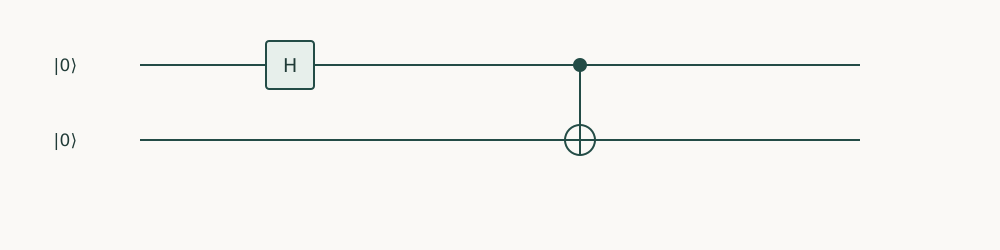
Bell-pair preparation. A Hadamard followed by CNOT makes (|00⟩+|11⟩)/√2. The first wire is the control.
Conditioning selects one branch; Bob's own prediction sums all of them. To use the conditional state he must know which branch each trial belongs to, and that requires Alice's record. When the record arrives, Bob can sort his earlier data and find strong correlations. Nothing reached him before the record did.
Problems
Problem 9.2. Does deleting Alice’s measurement record restore Bob’s knowledge of her outcome?
Worked solution
No. It removes the conditioning information. Bob retains the unconditioned reduced state and cannot infer which branch occurred from an arbitrary single local measurement.
9.3 Scope of Impossibility
An impossibility theorem forbids one precisely stated task. Read loosely, it can seem to forbid much more. Which input sets can be copied after all? And does the theorem survive if we accept copies that are only approximate, or that sometimes fail? We find the exact boundary for exact copying, then look at the two relaxations.
The overlap argument allowed \(s=0\) and \(s=1\). Which sets of pure states can one device copy exactly?
Apply the argument to each pair in the set. Every pair must be orthogonal or identical. Conversely, a set of mutually orthogonal states can be copied: measure in a basis containing them and prepare two copies of the result. So a set of pure states can be cloned exactly by one device exactly when its distinct members are mutually orthogonal. The basis states \(\ket0,\ket1\) qualify; the set \(\{\ket0,\ket1,\ket+\}\) does not.
Two further qualifications matter. A known state is no problem at all: whoever knows its description can prepare it again as often as resources allow. And the theorem concerns one device acting on an unknown member of the set, exactly and on every trial. It says nothing against devices that only approximate, or that sometimes refuse to answer.
The overlap argument needed exact copies. Does "almost copying" escape it? To answer we need a measure of "almost". For a pure target \(\ket\psi\) and an output \(\sigma\), use the probability that \(\sigma\) passes the test for \(\psi\), \(F=\bra\psi\sigma\ket\psi\). This number is the fidelity of the output with the target; it is 1 for a perfect copy.
A crude copier measures Z and prepares two copies of the result. On \(\ket0\) both outputs have fidelity 1. On \(\ket+\) each output is \(\ket0\) or \(\ket1\), which passes the plus test with probability \(1/2\). So its fidelity depends strongly on the input. Can one device do equally well on every input? We quote the answer: the best such universal copier for qubits gives each output fidelity \(5/6\) for every pure input (Bužek and Hillery, 1996; optimality shown by Gisin and Massar, 1997). Approximate copies are possible, with a fidelity strictly below one.
A different relaxation keeps the copies exact but allows the device to fail on some trials and say so. For linearly independent sets of states, such probabilistic exact cloning is possible (Duan and Guo, 1998). The failures are declared, so they do not contradict the deterministic theorem.
So every claim of impossibility must say which inputs, which resources and which success criterion it concerns. A security argument built on no-cloning is only as good as the match between those assumptions and the real protocol.
Copying and signalling are ruled out. What can a shared Bell pair accomplish, then, when it is combined with ordinary communication?
Problem 9.3. Would a copier for a known single state violate the theorem?
Worked solution
No. There are no conflicting nonorthogonal alternatives to preserve. A known preparation circuit can produce as many copies as its resources permit.
Transfer problem. For the commuting family \(\rho_q\), compare the broadcast output with \(\rho_q\otimes\rho_q\) at q=1/2. Which measurement distinguishes them statistically?
Worked solution
The broadcast output gives only 00 and 11, each with probability one half. The independent tensor-square gives all four bit pairs with probability one quarter. Measure both outputs in Z and compare agreement rates: one versus one half. Both constructions have exactly the same individual marginals.
Summary
The no-cloning and no-broadcasting theorems forbid any unitary or channel from copying an arbitrary unknown state \(|\psi\rangle \mapsto |\psi\rangle\otimes|\psi\rangle\) because linearity and inner-product preservation conflict for non-orthogonal states.
The no-signaling theorem ensures that local measurements or channels applied on Bob’s share of an entangled state never alter Alice’s reduced density matrix \(\rho_A\).
Monogamy of entanglement limits how strongly a single quantum system can be entangled with two different partners simultaneously.
Questions and worked problems
These exercises draw on the whole chapter. Attempt each question before opening a hint, explain your reasoning, then compare it with the worked solution.
For which of these input sets can one fixed unitary (with any environment) copy every member exactly? (a) \(\{\ket0,\ket1\}\); (b) \(\{\ket+,\ket-\}\); (c) \(\{\ket0,\ket+\}\); (d) \(\{\ket0,-\ket0\}\). Use the condition \(s\le s^2\) on the overlap magnitude.
Hint 1
The overlap condition allows only \(s=0\) or \(s=1\).
Hint 2
\(\ket0\) and \(-\ket0\) are the same physical state.
Worked solution
(a) and (b) are orthogonal pairs, \(s=0\), so copying is allowed; a CNOT copies (a), and \(H\) followed by CNOT and \(H\otimes H\) copies (b). (c) has \(s=1/\sqrt2\), and \(s\le s^2\) fails: no cloner exists. (d) has \(s=1\): the two vectors describe one physical state, and re-preparing it is trivially possible. Only sets of mutually orthogonal (or identical) states can be cloned deterministically.
Can one channel broadcast both members of each family? (a) \(\mathrm{diag}(0.7,0.3)\) and \(\mathrm{diag}(0.2,0.8)\); (b) \(\mathrm{diag}(0.7,0.3)\) and \(\ket+\bra+\). Decide by checking whether the matrices commute.
Hint 1
Diagonal matrices always commute.
Hint 2
Compute \(\rho\sigma\) and \(\sigma\rho\) for (b).
Worked solution
(a) Both are diagonal, so they commute and can be broadcast: measure \(Z\) and write the result into two registers. (b) \(\mathrm{diag}(0.7,0.3)\,\ket+\bra+=\frac12\begin{pmatrix}0.7&0.7\\0.3&0.3\end{pmatrix}\), while the reverse product is \(\frac12\begin{pmatrix}0.7&0.3\\0.7&0.3\end{pmatrix}\). They differ, so the pair does not commute and, by the broadcasting theorem, no channel gives both outputs the correct marginals for both inputs.
Alice and Bob share \(\ket{\Phi^+}\). Alice resets her qubit to \(\ket0\) (swap with a fresh ancilla and discard). Find the new joint state and Bob’s reduced state. Has Alice’s drastic operation signalled anything to Bob?
Hint 1
Discarding Alice’s original qubit leaves Bob with its partner’s reduced state.
Hint 2
The new joint state is a product.
Worked solution
After the reset, Alice holds \(\ket0\), unentangled with Bob, and Bob’s qubit is the reduced state of the original pair: \(\rho_B=I/2\). The joint state is \(\ket0\bra0\otimes I/2\). Bob’s statistics are exactly what they were before, even though Alice destroyed the entanglement. Any trace-preserving local operation leaves the other party’s reduced state unchanged, which is the content of no-signalling.
CNOT copies basis states. Use it as an attempted cloner on \(\ket\psi=\cos\theta\ket0+\sin\theta\ket1\) with a blank target. (a) Find the overlap of the output with the ideal two copies \(\ket\psi\ket\psi\), and the fidelity (its squared magnitude). (b) Find the fidelity of one output qubit’s reduced state with \(\ket\psi\). (c) Evaluate both at \(\theta=0\) and \(\theta=\pi/4\).
Hint 1
The output is \(\cos\theta\ket{00}+\sin\theta\ket{11}\).
Hint 2
Each output qubit has reduced state \(\mathrm{diag}(\cos^2\theta,\sin^2\theta)\).
Worked solution
(a) \(\braket{\psi\psi}{\text{out}}=\cos\theta\cos^2\theta+\sin\theta\sin^2\theta=\cos^3\theta+\sin^3\theta\), so the fidelity is \((\cos^3\theta+\sin^3\theta)^2\). (b) Each output is \(\mathrm{diag}(\cos^2\theta,\sin^2\theta)\), with fidelity \(\bra\psi\rho\ket\psi=\cos^4\theta+\sin^4\theta\). (c) At \(\theta=0\) both are \(1\): basis states are copied perfectly. At \(\theta=\pi/4\) (\(\ket+\)) the joint fidelity is \(\big(2\cdot2^{-3/2}\big)^2=\frac12\) and each output has fidelity \(\frac12\): the outputs are maximally mixed rather than copies. A copier designed for one basis does poorly on superpositions.
Alice and Bob share \(\ket\Psi=\frac{1}{\sqrt3}(\ket{00}+\ket{01}+\ket{11})\). Alice measures in the \(\pm\) basis and does not report the result. (a) Find the probability of each of her outcomes and Bob’s conditional state. (b) Compute Bob’s probability of \(0\) averaged over her outcomes, and compare with his probability before her measurement.
(a) Outcome \(+\) has probability \(\frac16(1+4)=\frac56\) and leaves Bob in \((\ket0+2\ket1)/\sqrt5\); outcome \(-\) has probability \(\frac16\) and leaves Bob in \(\ket0\). (b) Bob’s probability of \(0\) is \(\frac56\cdot\frac15+\frac16\cdot1=\frac13\). Before Alice measured, it was \(|\alpha_{00}|^2+|\alpha_{10}|^2=\frac13\). The conditional states are very different, but the average is the same, as the completeness argument of Section 9.2.1 guarantees for every local operation.
Show that perfect cloning would allow signalling. Alice and Bob share many Bell pairs; for each pair, Alice measures either all in \(Z\) or all in \(X\), to send one bit. Suppose Bob could make \(10\) copies of his qubit. What would he observe on the copies in each case, and how could he read Alice’s choice? What does this say about the relation between no-cloning and no-signalling?
Hint 1
If Alice measured \(Z\), Bob’s qubit is \(\ket0\) or \(\ket1\); if \(X\), it is \(\ket+\) or \(\ket-\).
Hint 2
Measure all copies in \(Z\) and see whether they agree.
Worked solution
If Alice measured \(Z\), Bob’s qubit is \(\ket0\) or \(\ket1\), and ten copies measured in \(Z\) all give the same result. If she measured \(X\), his qubit is \(\ket+\) or \(\ket-\), and ten \(Z\) measurements give independent fair bits, all agreeing with probability only \(2\cdot2^{-10}\approx0.002\). So Bob could read Alice’s choice, and hence a message, instantly, with an error under \(1\%\). Since no-signalling holds for every local operation, a perfect cloner cannot exist. No-cloning is part of what keeps quantum correlations from carrying messages without communication.
For the commuting family \(\rho_q=q\ket0\bra0+(1-q)\ket1\bra1\), the broadcaster measures \(Z\) and writes the result into two registers. For \(q=0.8\), compute the probability that the two outputs agree, and compare with two independent samples from \(\rho_q\otimes\rho_q\). Find the mutual information between the two outputs in each case.
Hint 1
The broadcast outputs always agree.
Hint 2
Independent samples agree with probability \(q^2+(1-q)^2\).
Worked solution
The broadcast output \(0.8\ket{00}\bra{00}+0.2\ket{11}\bra{11}\) gives agreeing bits with probability \(1\), while independent samples agree with probability \(0.64+0.04=0.68\). The broadcast outputs share \(h_2(0.2)\approx0.722\) bits of mutual information (each output determines the other), while independent copies share none. Both have the correct marginal \(\rho_q\). Broadcasting reproduces each part correctly but correlates the parts, which is why it is weaker than copying.
A student argues: “No-cloning says a quantum state cannot exist in two places, so teleportation, which makes Bob’s qubit equal to Alice’s input, must violate it.” Explain why it does not, describing what happens to Alice’s system during the protocol.
Hint 1
After Alice’s measurement, what state does her input qubit hold?
Hint 2
Is there ever a moment when two systems both hold the unknown state?
Worked solution
In teleportation Alice measures her input qubit together with her half of the Bell pair. After the measurement, her qubits are in definite basis states that carry no information about the input amplitudes. Bob’s qubit becomes the input state only after he applies the correction selected by her classical message. At no time do two systems both hold the unknown state, so nothing is copied: the state is transferred, and the original is consumed. No-cloning forbids duplication, not relocation.
A measure-and-prepare cloner measures \(Z\) and prepares two copies of the outcome state. (a) Find the fidelity of each copy with the input for \(\ket0\), \(\ket1\), \(\ket\pm\), and \((\ket0\pm i\ket1)/\sqrt2\). (b) Average over these six inputs. (c) Compare with the known optimal universal cloner, whose copies have fidelity \(\frac56\) for every input.
Hint 1
For \(\ket+\), each copy is \(\ket0\) or \(\ket1\) with probability \(\frac12\).
Hint 2
Fidelity of \(\ket j\) with \(\ket\psi\) is \(|\braket j\psi|^2\).
Worked solution
(a) For \(\ket0\) and \(\ket1\) the copies are perfect: fidelity \(1\). For the other four inputs, the copies are \(\ket0\) or \(\ket1\) at random, each with fidelity \(\frac12\) with the input. (b) The average is \(\frac16(1+1+4\cdot\frac12)=\frac23\). (c) The optimal universal cloner of Bužek and Hillery reaches \(\frac56\) for every input, without favoring a basis. Approximate cloning is possible, but with fidelity strictly below \(1\); better cloners must keep the copies entangled rather than measuring first.
Construct a probabilistic exact cloner for \(\{\ket0,\ket+\}\) from unambiguous discrimination: on a conclusive outcome, prepare two copies of the identified state; otherwise declare failure. (a) What is its success probability? (b) Why does it not violate no-cloning? (c) The optimal probabilistic cloner for two states with overlap \(s\) succeeds with probability \(1/(1+s)\). Evaluate it and compare.
Hint 1
Unambiguous discrimination succeeds with probability \(1-s\).
Hint 2
No-cloning forbids deterministic exact copying.
Worked solution
(a) With \(s=1/\sqrt2\), unambiguous discrimination succeeds with probability \(1-\frac{1}{\sqrt2}\approx0.293\), and on success Bob knows the state and prepares as many copies as he likes. (b) The procedure sometimes fails and says so; no-cloning forbids only an exact copier that always succeeds on every member of a nonorthogonal set. (c) \(1/(1+s)\approx0.586\), the Duan–Guo bound, which is achieved by a cloner that does not first identify the state. Asking for exactly two copies, rather than full knowledge, roughly doubles the success probability.