Starting point: Bell pairs, Pauli-type operations X and Z, no-cloning and no-signalling; each protocol specifies its resources and communication assumptions.
Keep in view: Teleport an unknown qubit using a Bell pair and two classical bits.
The constraints are now clear. No device copies an unknown state, and no operation on one half of an entangled pair changes the statistics at the other half. A Bell pair alone cannot carry a message.
What, then, is a shared Bell pair good for? Combined with ordinary communication it does three things that look impossible at first sight. It moves an unknown qubit using only classical bits, although Alice can neither copy nor read the state. It lets one transmitted qubit carry two classical bits, although an unassisted qubit carries at most one. And it can entangle two systems that never met. For each protocol we expand the joint state into branches labelled by measurement outcomes, find the operation that makes the branches useful, and then count every resource consumed. The counting shows why none of them violates the constraints.
10.1 Teleportation
Alice holds a qubit in an unknown state \(\ket\psi\). She shares a Bell pair with Bob and can phone him. She cannot copy \(\ket\psi\), and one measurement cannot reveal its amplitudes. Can she still get the state to Bob? We expand the three-qubit state and find that Bob's qubit is already related to \(\ket\psi\) in every branch. A joint measurement on Alice's side sorts the branches, and a correction on Bob's side, chosen by her two bits, finishes the job.
Call Alice's unknown qubit S and the Bell pair A, B, with A on Alice's side. We order the registers S, A, B. With \(\ket\psi=\alpha\ket0+\beta\ket1\), the starting state is
A first attempt fails at once. If Alice measures S in Z, she keeps only \(\alpha\) or only \(\beta\), and the other amplitude is gone. She needs a measurement that does not single out either amplitude.
Look at where the amplitudes sit. Bob's qubit carries \(\alpha\ket0\) when SA reads 00, and \(\beta\ket1\) when SA reads 11. To leave Bob with \(\alpha\ket0+\beta\ket1\), those two terms must end up in the same measurement outcome. A CNOT from S to A does the grouping. It exchanges SA labels 10 and 11 and leaves 00 and 01 alone:
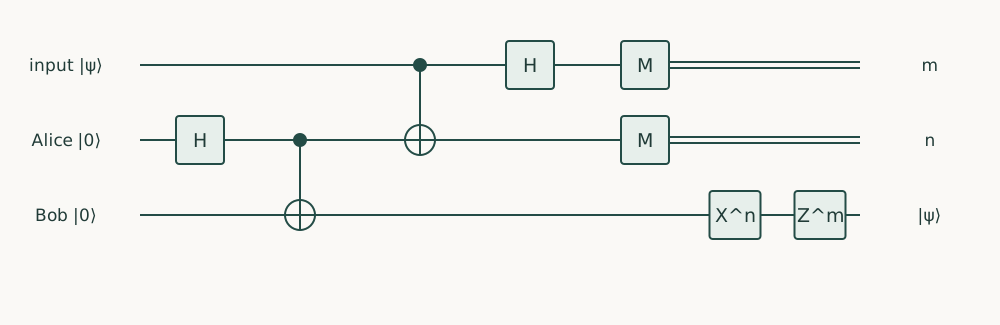
Now A reads 0 in the terms \(\alpha\ket{0}_S\ket0_B\) and \(\beta\ket1_S\ket1_B\). The right amplitudes are together, but S still records which one is which. That record would spoil the superposition, just as a path record destroyed interference. So Alice must read S in a way that cannot tell 0 from 1. Applying \(H\) to S and then measuring Z does exactly that, because \(H\ket0\) and \(H\ket1\) give each outcome with probability \(1/2\).
After the \(H\), collect the terms by the SA labels \(m\) and \(n\). For 00 Bob's column is \((\alpha,\beta)/2\); for 01 it is \((\beta,\alpha)/2\); for 10 it is \((\alpha,-\beta)/2\); and for 11 it is \((-\beta,\alpha)/2\). In compact form,
Each pair of outcomes has probability \(1/4\), whatever \(\ket\psi\) is, because \(|\alpha|^2+|\beta|^2=1\). So Alice's two bits reveal nothing about the amplitudes. In every branch Bob holds \(\ket\psi\) up to a known operation: \(\ket\psi\), \(X\ket\psi\), \(Z\ket\psi\) or \(XZ\ket\psi\).
10.1.2 Conditional corrections and resource consumption§
Alice sends \(m\) and \(n\) to Bob. What must he do with them? In branch \(mn\) he holds \(X^nZ^m\ket\psi\). He applies \(X\) if \(n=1\) and then \(Z\) if \(m=1\), which is \(Z^mX^n\). Since \(X^2=Z^2=I\), the product \(Z^mX^nX^nZ^m\) is \(I\), and he recovers \(\ket\psi\).
Take outcome 11. Bob holds \(XZ\ket\psi\), applies \(X\) and then \(Z\), and gets \(ZX\,XZ\ket\psi=\ket\psi\). The order matters: the rightmost operation acts first. The four corrections \(I,X,Z,XZ\) are the Pauli operations on a qubit, and they recur throughout quantum information.
Teleportation with classical feedforward. Alice’s top measurement gives m and the middle gives n; Bob applies X^n then Z^m using the communicated records. No quantum control from the measured wires is implied.
Does Bob have the state before the bits arrive? Average his four branches: \(\tfrac14(\rho+X\rho X+Z\rho Z+XZ\rho ZX)\), where \(\rho=\ket\psi\bra\psi\). Averaging over \(Z\) removes the off-diagonal entries, and averaging over \(X\) then equalizes the diagonal ones, so the result is \(I/2\) for every input. Bob's qubit carries no trace of \(\ket\psi\) until he learns \(m,n\), as no-signalling requires.
Now count what was used. One Bell pair was consumed; a Bell pair used as a resource in this way is called an ebit. Two classical bits were sent. Alice's original qubit was measured, so \(\ket\psi\) no longer exists on her side, and no copy was made. The protocol is teleportation (Bennett and coauthors, 1993): one ebit plus two classical bits transfer one unknown qubit.
Problems
Problem 10.1. For teleportation outcome m=1,n=0, what correction is required?
Worked solution
Bob holds Zψ and applies Z. Applying X instead generally gives the wrong state.
10.2 Dense Coding
Teleportation spent two classical bits and an ebit to move one qubit. Can the trade run the other way, so that one qubit and an ebit move two classical bits? By itself one qubit carries at most one bit of accessible information. We let Alice encode with Pauli operations on her half of the pair, which produces four orthogonal states. Then we find Bob's decoder, which turns out to be the measurement Alice used in teleportation, and check the resource count against the one-bit limit.
10.2.1 Encoding classical messages in a shared pair§
Alice and Bob share \(\ket{\Phi^+}\). Alice wants to send two bits \(a,b\). She applies \(X^bZ^a\) to her half only. What joint states can she make?
Doing nothing leaves \(\ket{\Phi^+}\). \(Z\) gives \(\ket{\Phi^-}=(\ket{00}-\ket{11})/\sqrt2\). \(X\) exchanges Alice's labels and gives \((\ket{10}+\ket{01})/\sqrt2\). \(XZ\) gives \((\ket{10}-\ket{01})/\sqrt2\). We name the two new states \(\ket{\Psi^\pm}=(\ket{01}\pm\ket{10})/\sqrt2\), so the last one is \(-\ket{\Psi^-}\), which differs only by a global phase.
Are the four states distinguishable? The \(\Phi\) states use the configurations 00 and 11, and the \(\Psi\) states use 01 and 10, so every \(\Phi\) is orthogonal to every \(\Psi\). Within each pair, the inner product is \((1-1)/2=0\). So \(\ket{\Phi^\pm},\ket{\Psi^\pm}\) are four orthonormal vectors in a four-dimensional space. They form the Bell basis.
Alice's operation acts only on her half, so Bob's reduced state is \(I/2\) in all four cases. No-signalling holds: before Alice sends anything, Bob learns nothing. Then Alice sends her qubit to Bob, who now holds both halves and can measure them jointly.
How does Bob tell the four Bell states apart? He can undo the circuit that made \(\ket{\Phi^+}\). A CNOT from the received qubit to his own, followed by \(H\) on the received qubit, sends each Bell state to a computational state. A Z measurement of both qubits then reads \(a,b\).
Dense-coding branches, with Alice’s received wire first
Message \(a,b\)
Joint state after encoding
Decoded bits
00
\((\ket{00}+\ket{11})/\sqrt2\)
00
01
\((\ket{01}+\ket{10})/\sqrt2\)
01
10
\((\ket{00}-\ket{11})/\sqrt2\)
10
11
\((\ket{10}-\ket{01})/\sqrt2\)
11
Check one row. For message 10, CNOT sends \((\ket{00}-\ket{11})/\sqrt2\) to \((\ket{00}-\ket{10})/\sqrt2=\ket-\ket0\), and \(H\) on the first wire gives \(\ket{10}\). For message 11 the decoder gives \(-\ket{11}\), and the minus sign is global. Every message is decoded with certainty.
This decoder is the joint measurement Alice made in teleportation: CNOT, then \(H\), then two readouts. It measures in the Bell basis, so it is called a Bell measurement.
Count the resources. Alice sent one qubit, and one ebit was consumed; two classical bits arrived. Does that break the one-bit limit for a qubit? No. That limit concerns a qubit sent without prior shared entanglement. Here Bob also held the other half of a Bell pair and decoded both halves together. The protocol is dense coding (Bennett and Wiesner, 1992).
Problems
Problem 10.2. Why does dense coding not contradict a one-bit unassisted qubit bound?
Worked solution
It consumes pre-shared entanglement and uses a joint two-qubit decoder. The resource model differs from sending an unassisted qubit.
10.3 Entanglement Swapping
Teleportation moves the state of a qubit. What if that qubit is itself half of another Bell pair? Then the entanglement should move too, onto systems that have never interacted. We compute the branches of a Bell measurement on the two middle qubits of two pairs. Then we ask what the endpoints have before and after they learn its outcome, and what a real chain of such links would need.
Project B, C onto \(\ket{\Phi^+}\). Only terms with B and C equal survive, the first and the last, and each picks up the amplitude \(1/\sqrt2\). What is left for A, D is \((\ket{00}+\ket{11})/(2\sqrt2)\). Its squared length is \(1/4\), so this outcome has probability \(1/4\), and normalizing leaves A, D in \(\ket{\Phi^+}\).
The other three outcomes work the same way: a Bell measurement result \(\ket{\Phi^-},\ket{\Psi^+}\) or \(\ket{\Psi^-}\) on B, C leaves A, D in the same Bell state, each with probability \(1/4\). This is entanglement swapping. A and D never interacted; the entanglement came from the two original pairs and the middle measurement.
What do A and D hold if nobody tells them the outcome? The average of the four Bell projectors. Their off-diagonal entries cancel, and the result is \(I/4\). That is also what A and D held before the measurement, since each was half of a separate pair. No-signalling holds again.
So the endpoints need the middle station's record. What do they do with it? The record names their Bell state. They can apply a Pauli correction to turn it into \(\ket{\Phi^+}\), or they can simply note which correction is owed and account for it in later calculations. Keeping such a record instead of applying the correction is called tracking the Pauli frame.
Count the resources once more. Two Bell pairs were consumed to make one longer one, and two classical bits travelled from the middle station. Chaining swaps could in principle connect distant nodes. In practice, loss in each link, imperfect pairs, limited quantum memories and the time for classical messages all reduce the rate. Ideal swapping is a component of such a network, not a complete design for one.
Every protocol here began with a pure Bell pair whose halves were each maximally uncertain. How much uncertainty is that, and how should we measure the correlation and entanglement between the halves?
Problem 10.3. Can the endpoints use a particular swapped Bell state before learning the middle result?
Worked solution
They cannot identify its Pauli frame. Their unconditioned joint state is the equal mixture of four Bell states, I/4.
Transfer problem. Alice sends only the teleportation record n and withholds m. After correcting X using n, what state does Bob have? Which input states still survive?
Worked solution
Correcting X leaves the equally likely branches \(\ket\psi\) and \(Z\ket\psi\). Their average density matrix is \((\rho+Z\rho Z)/2=\mathrm{diag}(|\alpha|^2,|\beta|^2)\). Basis states survive, while general relative phase is lost. One correction bit preserves less than an arbitrary unknown qubit.
Summary
Quantum teleportation consumes one shared ebit \(|\Phi^+\rangle_{AB}\) and two classical bits from Alice’s Bell measurement to transfer an unknown qubit state \(|\psi\rangle\) to Bob without sending a physical qubit across the channel.
Superdense coding reverses the resource trade-off: applying one of four local Pauli gates to half of a shared Bell pair lets a single transmitted qubit convey two bits of classical information.
Entanglement swapping applies a joint Bell measurement on two independent entangled pairs \(AB\) and \(CD\) to entangle remote terminals \(A\) and \(D\) that have never interacted directly.
Questions and worked problems
These exercises draw on the whole chapter. Attempt each question before opening a hint, explain your reasoning, then compare it with the worked solution.
Teleport \(\ket\psi=\ket1\). For Alice’s outcomes \(01\) and \(11\), write Bob’s state before correction and check that his corrections recover \(\ket1\).
Hint 1
Bob holds \(X^nZ^m\ket\psi\) and applies \(X^n\), then \(Z^m\).
Hint 2
\(Z\ket1=-\ket1\).
Worked solution
For \(01\) (\(m=0,n=1\)), Bob holds \(X\ket1=\ket0\) and applies \(X\), recovering \(\ket1\). For \(11\), he holds \(XZ\ket1=X(-\ket1)=-\ket0\); applying \(X\) gives \(-\ket1\), then \(Z\) gives \(\ket1\). The input was a basis state, yet Bob still needs both bits: without them he cannot tell \(\ket0\) from \(\ket1\) in his hands, and his unconditioned state is \(I/2\).
In dense coding, trace the decoder (CNOT from Alice’s received qubit to Bob’s, then \(H\) on the received qubit) for the messages \(01\) and \(11\), starting from the encoded states in the table.
Hint 1
CNOT maps \(\ket{\Psi^\pm}\) to \(\ket\pm\ket1\).
Hint 2
\(H\ket\pm\) gives \(\ket0\) or \(\ket1\).
Worked solution
Message \(01\): the encoded state is \((\ket{01}+\ket{10})/\sqrt2\); CNOT gives \((\ket{01}+\ket{11})/\sqrt2=\ket+\ket1\), and \(H\) gives \(\ket{01}\). Message \(11\): the encoded state is \((\ket{10}-\ket{01})/\sqrt2\); CNOT gives \((\ket{11}-\ket{01})/\sqrt2=-\ket-\ket1\), and \(H\) gives \(-\ket{11}\). Both decode correctly with certainty; the sign is global.
Count the resources: (a) teleporting five unknown qubits; (b) sending ten classical bits by dense coding; (c) sending ten classical bits with no shared entanglement, one bit per transmitted qubit. Which resources does each consume?
Hint 1
Teleportation: one ebit and two bits per qubit.
Hint 2
Dense coding: one ebit and one transmitted qubit per two bits.
Worked solution
(a) Five shared Bell pairs and ten classical bits; no qubit is sent during the protocol. (b) Five Bell pairs and five transmitted qubits. (c) Ten transmitted qubits (or ten classical bits sent directly). Dense coding halves the qubits sent only by spending pre-shared entanglement, which itself required sending qubits earlier. Protocol comparisons must count every resource, including entanglement distributed in advance.
In dense coding, Alice’s qubit suffers a phase flip \(Z\) with probability \(p\) on its way to Bob. (a) Show that a \(Z\) on Alice’s qubit after encoding \(X^bZ^a\) turns the encoded state into the one for message \((a\oplus1,b)\), up to sign. (b) Find the probability that each decoded bit is wrong. (c) What happens with bit-flip noise \(X\) instead?
Hint 1
\(ZX^bZ^a=\pm X^bZ^{a+1}\).
Hint 2
An \(X\) error changes \(b\).
Worked solution
(a) \(ZX^bZ^a=(-1)^bX^bZ^{a\oplus1}\), so the joint state becomes, up to sign, the encoding of \((a\oplus1,b)\). (b) The decoder then returns \(a\oplus1\): the first bit is wrong with probability \(p\), and the second bit is always right. (c) An \(X\) error gives \(X^{b\oplus1}Z^a\), so the second bit is wrong with probability \(p\) and the first is untouched. Each Pauli error on the transmitted qubit maps one Bell state to another, so the noise appears as a classical error on specific message bits.
Teleportation is attempted with the shared pair \(\ket{\Phi^-}=(\ket{00}-\ket{11})/\sqrt2\) by mistake, and Bob applies the usual corrections. (a) Using \(\ket{\Phi^-}=(I\otimes Z)\ket{\Phi^+}\), show that Bob ends with \(Z\ket\psi\) up to sign in every branch. (b) For which inputs is the protocol still correct? (c) How could the error be repaired?
Hint 1
A \(Z\) on Bob’s qubit commutes with all of Alice’s operations.
Hint 2
\(Z^mX^nZX^nZ^m=(-1)^nZ\).
Worked solution
(a) The \(Z\) acts on Bob’s qubit, which Alice never touches, so in each branch Bob holds \(ZX^nZ^m\ket\psi\). His correction gives \(Z^mX^nZX^nZ^m\ket\psi=(-1)^nZ\ket\psi\), using \(XZX=-Z\) and \(Z^mZZ^m=Z\). (b) The output equals the input (up to phase) only for eigenstates of \(Z\), \(\ket0\) and \(\ket1\); for \(\ket+\) Bob receives \(\ket-\), an orthogonal state. (c) If the pair is known to be \(\ket{\Phi^-}\), Bob adds a final \(Z\). Teleportation transfers whatever Pauli error the shared pair carries onto the output, so the quality of the shared entanglement sets the quality of the transfer.
In entanglement swapping with order \(A,B,C,D\), the initial state is \(\frac12(\ket{0000}+\ket{0011}+\ket{1100}+\ket{1111})\). Project \(B,C\) onto \(\ket{\Psi^-}=(\ket{01}-\ket{10})/\sqrt2\), find the probability of this outcome, and identify the endpoints’ state.
Hint 1
Only terms with \(BC=01\) or \(BC=10\) survive.
Hint 2
\(\ket{0011}\) has \(BC=01\) and \(AD=01\); \(\ket{1100}\) has \(BC=10\) and \(AD=10\).
Worked solution
Only \(\ket{0011}\) (\(BC=01\), \(AD=01\)) and \(\ket{1100}\) (\(BC=10\), \(AD=10\)) survive. The projection gives \(\frac12\cdot\frac{1}{\sqrt2}(\ket{01}_{AD}-\ket{10}_{AD})\), with squared length \(\frac14\), so the outcome has probability \(\frac14\) and leaves the endpoints in \(\ket{\Psi^-}\). The middle measurement outcome names which Bell state \(A\) and \(D\) now share; without that record, the four equally likely possibilities average to \(I/4\).
Show that the classical record \((m,n)\) sent in teleportation carries no information about \(\ket\psi\). (a) Find the joint probability of \((m,n)\) for any input. (b) Suppose Eve copies the two bits but has no access to Bob’s qubit. What does she learn? (c) What could Eve do with Bob’s qubit alone, without the bits?
Hint 1
Every branch has squared length \(\frac14\) regardless of \(\alpha,\beta\).
Hint 2
Bob’s unconditioned state is \(I/2\).
Worked solution
(a) Each of the four outcomes has probability \(\frac14\) for every input, so the record is uniformly random and independent of \(\ket\psi\). (b) Eve learns nothing about \(\alpha,\beta\): the bits are statistically identical for every input. (c) Without the bits, Bob’s qubit (or Eve’s, if she stole it) is in \(I/2\) for every input, again carrying no information. The input’s description resides in the correlation between the bits and the qubit; neither part alone reveals it.
A student says: “Bob must apply \(X^n\) before \(Z^m\); in the other order, outcome \(11\) leaves him with the wrong state.” Check what happens if Bob applies \(Z\) first and then \(X\) in branch \(11\), where he holds \(XZ\ket\psi\).
Hint 1
Compute \(XZ\cdot XZ\).
Hint 2
\(ZX=-XZ\).
Worked solution
Applying \(Z\), then \(X\), gives \(XZ\,XZ\ket\psi\). Since \(ZX=-XZ\), \(XZXZ=-XXZZ=-I\), so Bob holds \(-\ket\psi\). That differs from \(\ket\psi\) only by a global phase, which no measurement detects. The order of the two corrections does not matter for teleporting a standalone qubit. It would matter if Bob’s qubit were later used as the control of an operation, or if the correction were itself controlled, because the sign would then become a relative phase between branches.
Alice’s input qubit \(S\) is half of an entangled pair with a reference \(R\): \(\frac{1}{\sqrt2}(\ket{0}_R\ket{0}_S+\ket1_R\ket1_S)\). She teleports \(S\) to Bob. (a) Use linearity of the branch formula to show that, after Bob’s correction, \(R\) and \(B\) share the same entangled state. (b) What does this say about teleportation as a channel? (c) Relate the result to entanglement swapping.
Hint 1
Apply the branch formula separately to the \(\ket0_S\) and \(\ket1_S\) terms.
Hint 2
The correction \(Z^mX^n\) does not depend on the input.
Worked solution
(a) The branch formula holds for each basis input, and Alice’s operations and Bob’s correction do not depend on the input, so by linearity the whole superposition is carried through: in every branch, after correction, the state is \(\frac{1}{\sqrt2}(\ket0_R\ket0_B+\ket1_R\ket1_B)\). (b) Teleportation acts as the identity channel on \(S\), including on correlations with systems it never touches; it transfers states, entanglement included, not just a list of amplitudes. (c) This is entanglement swapping: teleporting one half of a Bell pair entangles the other half with the receiver, which is how quantum repeaters extend entanglement across links.
Dense coding sends two classical bits with one transmitted qubit and one ebit. Could a cleverer encoding send three bits with the same resources? Use the facts that Bob ends up holding two qubits, a four-dimensional system, and that at most \(\log_2d\) bits can be reliably read from a \(d\)-dimensional system (the Holevo bound). Also explain why, without the shared pair, one transmitted qubit carries at most one bit.
Hint 1
Count the dimension of everything Bob can measure.
Hint 2
Without entanglement, Bob receives only the one qubit.
Worked solution
After the transmission Bob holds two qubits, and every message must be decoded by a measurement on that four-dimensional system. At most \(\log_24=2\) bits can be reliably extracted, so dense coding is optimal: three bits are impossible. Without prior entanglement, Bob receives only one qubit, of dimension \(2\), giving at most \(\log_22=1\) bit. The shared pair doubles the capacity by letting Alice’s local operation choose among four orthogonal joint states, not by making one qubit hold more than its dimension allows.