Starting point: Unitaries, density operators, partial traces and purification; operator sums and complete positivity are developed through composite examples.
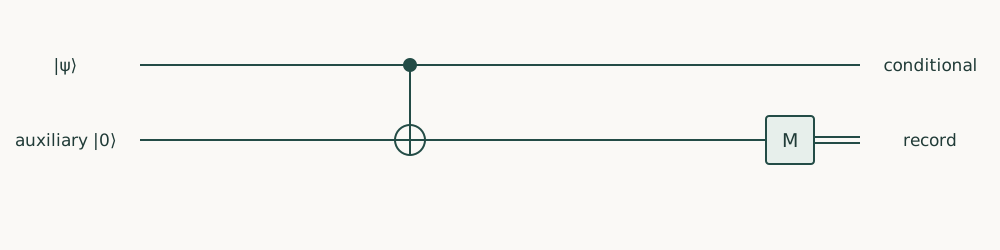
Keep in view: A qubit coupled to an auxiliary qubit that is subsequently discarded.
We now have two descriptions of a system. Alone and isolated, it has a pure state that evolves by a unitary. As part of something larger, or prepared at random, it has a density operator. Purification connected the two: every mixed state is part of some pure joint state.
Real qubits are never perfectly isolated. A unitary keeps every inner product, so it can never turn the pure state plus into the mixed state \(I/2\). Yet noise does exactly that. How can a process that is reversible for the whole look irreversible for the part we keep? We let the qubit interact with an auxiliary system and then discard it. Computing the result for the qubit alone gives a formula with a few matrices, the operator-sum form. Asking which such formulas are physical then forces two conditions: the total probability must stay one, and positivity must survive even when the qubit is entangled with something untouched. With these rules we can describe common noise, chain processes together, and show that no process can make two states easier to tell apart.
6.1 Physical Constructions
A qubit interacts with a second system, and then we lose track of the second one. What happens to the qubit we keep? We work this out for a CNOT record, the same device that destroyed interference, and see the coherences vanish. Then we state the general recipe, of which resetting a qubit is an extreme case.
Take a qubit in \(\ket\psi=a\ket0+b\ket1\) and an auxiliary qubit in \(\ket0\). Apply a CNOT from the qubit to the auxiliary. The pair becomes \(a\ket{00}+b\ket{11}\). Now suppose we keep only the first qubit. What is its state?
The partial trace over the auxiliary keeps terms whose auxiliary labels match. The diagonal entries survive as \(|a|^2\) and \(|b|^2\). The off-diagonal entry would pair auxiliary label 0 with label 1, so it vanishes:
Removing every off-diagonal entry in the computational basis is called complete dephasing. For a plus input, the kept qubit is \(I/2\), so a later X measurement is fair.
Has anything irreversible happened? Not to the pair. If we keep both qubits and apply CNOT again, the pair returns to \(\ket+\ket0\), and the X measurement gives plus with certainty. The joint unitary has an inverse. What we lost is access to the auxiliary, which holds a record of the computational label.
An auxiliary system used this way is called an ancilla. It may be an apparatus we control, or a model of an environment we cannot reach. Discarding it means our predictions no longer use it: we neither act on it nor condition on it. The object need not be destroyed.
The CNOT example has three steps: prepare an ancilla, apply a joint unitary, and discard part of the output. We take this as the general recipe for a physical process on an open system. How drastic can its effect on the kept qubit be?
Consider the swap, which exchanges two qubits' labels: \(\ket{x,y}\mapsto\ket{y,x}\). It permutes the four configurations, so it is unitary. Swap a qubit with an ancilla in \(\ket0\), then discard the ancilla. Whatever the input, the kept qubit is now \(\ket0\). This is a reset. Many inputs give the same output, so no operation on the kept qubit can undo it. The input state still exists; it has moved into the discarded system.
What if, instead of discarding the ancilla, we measure it and keep the result? After the CNOT, the ancilla's Z value equals the qubit's. Conditioning on the record leaves the qubit in \(\ket0\) or \(\ket1\), with probabilities \(|a|^2\) and \(|b|^2\). That is the projective measurement of the measurement postulate. Ignoring the record averages the two outcomes and gives complete dephasing again.
Measure the auxiliary after CNOT to record the system’s Z value. Ignoring the record gives dephasing; conditioning on it gives a projective state update.
Problems
Problem 6.1. What does the CNOT-and-discard construction do to plus and minus? Can an operation on the retained qubit recover both?
Worked solution
Both yield I/2 because their diagonal probabilities are the same. A single recovery map receives the same matrix in both cases and cannot output two different original states.
6.2 Quantum Channels
Each time we used the recipe, we built a joint state and took a partial trace. Is there a formula that acts on the kept qubit directly? Expanding the joint state by ancilla label gives one, the operator-sum form. Then we ask the converse: which formulas of that kind could describe a physical process? Total probability and positivity give the conditions, and an entangled input shows that ordinary positivity is not enough.
where \(K_0=\ket0\bra0\) keeps the zero component and \(K_1=\ket1\bra1\) keeps the one component. Tracing out the ancilla removes the cross terms between different labels, just as in a purification. What remains is \(K_0\ket\psi\bra\psi K_0^\dagger+K_1\ket\psi\bra\psi K_1^\dagger\). Averaging over any input ensemble gives
\[\mathcal E(\rho)=\sum_jK_j\rho K_j^\dagger.\]
For our two projectors this sum removes exactly the off-diagonal entries. Does every ancilla construction reduce to a few matrices sandwiching \(\rho\)? Take any joint unitary \(U\) with the ancilla starting in \(\ket0_E\). The output can always be sorted by ancilla label as \(\sum_j(K_j\ket\psi)\ket j_E\). Here \(K_j\) collects the system amplitudes attached to ancilla output \(j\), written \(K_j=\bra j_EU\ket0_E\). The same partial trace gives the same formula.
This is the operator-sum representation of the process, and the \(K_j\) are its Kraus operators. A process described this way is called a channel. Each \(K_j\) belongs to one ancilla branch. Nobody need see which branch occurred; if the ancilla is discarded, the branches are only averaged.
Suppose someone hands us matrices \(K_j\). When does \(\sum_jK_j\rho K_j^\dagger\) describe a physical process? Its output must be a density operator, so it must have trace one and be positive.
For the trace we need one fact. For matrices \(A\) and \(B\), \(\mathrm{tr}(AB)=\sum_{i,k}A_{ik}B_{ki}\). Exchanging the names of the two summed indices shows this equals \(\mathrm{tr}(BA)\). Moving each \(K_j\) around the trace,
This equals \(\mathrm{tr}\,\rho=1\) for every input exactly when \(\sum_jK_j^\dagger K_j=I\). A channel with this property is trace preserving. The ancilla construction always has it: \(\sum_jK_j^\dagger K_j=\bra0_EU^\dagger U\ket0_E=I\), because \(U\) is unitary. A single branch can have trace below one. Its trace is the probability of that branch.
Positivity also comes free: \(\bra v K_j\rho K_j^\dagger\ket v=\bra w\rho\ket w\geq0\) with \(\ket w=K_j^\dagger\ket v\). But is positivity of every output enough to make a map physical? Try the transpose, \(T(\rho)=\rho^T\). It keeps the trace, and it keeps positivity: \(\bra v\rho^T\ket v=\bra{v^*}\rho\ket{v^*}\), where \(v^*\) conjugates every entry.
Now apply the transpose to Alice's half of a Bell pair while Bob's half is untouched. Transposing Alice's labels sends \(\ket{ab}\bra{a'b'}\) to \(\ket{a'b}\bra{ab'}\). The Bell matrix \(\tfrac12(\ket{00}\bra{00}+\ket{00}\bra{11}+\ket{11}\bra{00}+\ket{11}\bra{11})\) becomes
Test it with \(\ket v=(\ket{01}-\ket{10})/\sqrt2\). Only the two middle terms contribute, and each gives \(-1/4\), so \(\bra v\rho'\ket v=-1/2\). A test would pass with probability \(-1/2\), which is impossible. So the transpose is not a physical operation on half of an entangled pair, even though it is harmless on a qubit by itself.
A map that keeps outputs positive even when it acts on one part of a larger system, with the rest untouched, is completely positive. Operator-sum maps have this property, because \(K_j\otimes I\) is again a sandwich of the same form. A quantum channel is a completely positive, trace-preserving map. We quote the converse without proof: every such map can be built by the ancilla recipe (a theorem due to Stinespring, with the operator-sum form due to Kraus).
Problems
Problem 6.2. Verify completeness for the dephasing operators K0 and K1.
Worked solution
The operators are the orthogonal projectors onto zero and one. Each squares to itself, so K0†K0+K1†K1=diag(1,0)+diag(0,1)=I.
6.3 Noise and Composition
Complete dephasing is the harshest noise of its kind. What do milder and different kinds look like, and what happens when processes follow one another? We describe two common qubit channels and find that they damage different things. Composing channels then gives a simple rule, and an argument about decisions shows that no channel helps a receiver tell states apart.
Suppose a stray field applies \(Z\) to a qubit on a fraction \(p\) of uses, and does nothing otherwise. What happens to the coherences? The phase-flip channel is
\[\mathcal E(\rho)=(1-p)\rho+pZ\rho Z,\]
with Kraus operators \(\sqrt{1-p}\,I\) and \(\sqrt p\,Z\). Conjugating by \(Z\) flips the sign of the off-diagonal entries and leaves the diagonal alone. So the off-diagonal entries are multiplied by \(1-2p\). On plus, an X measurement then gives plus with probability \(1-p\).
At \(p=1/2\) the coherences vanish, and the channel is complete dephasing again. At \(p=1\) every qubit receives the same known \(Z\), and plus becomes pure minus. A flip probability of one is not maximal ignorance; it is a known operation.
Random flips and known flips
Predict first. Predict which phase-flip probability makes a plus input most mixed. Compare one half with one.
For phase-flip probability p on plus, a plus/minus readout gives probabilities \(1-p,p\). At \(p=1/2\) the output is \(I/2\); at \(p=1\) it is pure minus. The circuit above realizes the completely dephasing midpoint by discarding its record.
A different physical process is decay. An atom in its excited level \(\ket1\) drops to \(\ket0\) with probability \(\gamma\), giving its energy to the surroundings. The amplitude-damping channel has Kraus operators
The second one moves \(\ket1\) to \(\ket0\). They satisfy \(K_0^\dagger K_0+K_1^\dagger K_1=\ket0\bra0+(1-\gamma)\ket1\bra1+\gamma\ket1\bra1=I\). On \(\rho=\begin{pmatrix}a&c\\c^*&b\end{pmatrix}\) the output is
At \(\gamma=0\) it is plus, and at \(\gamma=1\) it is \(\ket0\). In between, the populations shift towards 0 and the coherence shrinks. Phase-flip noise, by contrast, never changes the populations.
Could the two channels be confused? Choose \(p\) so that \(1-p=(1+\sqrt{1-\gamma})/2\). Then both give the same X-measurement statistics on plus. A Z measurement still tells them apart: phase flips leave it fair, while damping favours 0. Two noise mechanisms can agree in one experiment and differ in another.
6.3.2 Channel composition and accessible information§
A qubit passes through a channel with Kraus operators \(K_j\), then through one with operators \(L_l\). What is the combined channel? Substitute one formula into the other:
So the combined Kraus operators are the products \(L_lK_j\). The order matters, as it does for unitaries.
Can a channel ever help Bob tell two states apart? Suppose Alice sends \(\ket0\) or \(\ket+\) with equal probability, and Bob guesses which. With a Z measurement he guesses "zero" on outcome 0 and "plus" on outcome 1. He is right on every zero and on half of the pluses, so his success is \(\tfrac12\cdot1+\tfrac12\cdot\tfrac12=\tfrac34\). An X measurement, guessing "plus" on plus, also succeeds with probability \(3/4\).
Now let the qubit be completely dephased first. Zero stays \(\ket0\bra0\), and plus becomes \(I/2\). The Z statistics are unchanged, so the first strategy still succeeds with \(3/4\). The X strategy drops to \(1/2\), because both inputs now give plus half the time. The channel removed the coherence that the X strategy used. It added nothing that either strategy could use.
That is a general fact, and its proof is one sentence. Whatever Bob does after the channel, he could have done to the original input, by applying the channel himself and then doing it. So his best success after the channel is never more than his best success before. The information about Alice's label that the best measurement can extract is called accessible information. Processing cannot increase it. This is the quantum form of the data-processing principle. It concerns the best achievable decisions. A fixed measurement can do better after some channels than before: an X measurement cannot tell \(\ket0\) from \(\ket1\), but after a Hadamard it can.
A measurement is a channel whose branch record we keep instead of discarding. If Bob keeps that record, which states can he be left in, and which measurements become possible?
Problems
Problem 6.3. Does reversing the retained qubit alone undo complete dephasing?
Worked solution
No universal qubit-only inverse exists. Plus and minus both become I/2, so their distinction has been lost from the retained subsystem.
Transfer problem. Apply phase-flip noise with probability p twice independently. Find the net flip probability and explain the cases p=1/2 and p=1.
Worked solution
Exactly one flip occurs with probability \(2p(1-p)\); zero or two flips have no net effect since \(Z^2=I\). At p=1/2 the result is again complete dephasing. At p=1 the two known flips cancel and the net channel is the identity.
Summary
Physical transformations of open quantum systems are completely positive trace-preserving (CPTP) linear maps—quantum channels \(\mathcal{E}(\rho)\).
By the Kraus and Stinespring theorems, every quantum channel can be written both as an operator sum \(\mathcal{E}(\rho) = \sum_k K_k \rho K_k^\dagger\) with \(\sum_k K_k^\dagger K_k = I\) and as unitary coupling to an environment followed by partial trace.
Canonical qubit noise models—depolarizing, phase damping, and amplitude damping—contract the Bloch ball in characteristic ways and obey the data-processing inequality.
Questions and worked problems
These exercises draw on the whole chapter. Attempt each question before opening a hint, explain your reasoning, then compare it with the worked solution.
Apply the phase-flip channel \((1-p)\rho+pZ\rho Z\) with \(p=0.1\) to \(\ket+\bra+\). Give the output matrix and the probability that a \(\pm\) test returns \(+\).
The diagonal stays \((\frac12,\frac12)\) and the coherences become \(\frac12(1-0.2)=0.4\), so the output is \(\begin{pmatrix}0.5&0.4\\0.4&0.5\end{pmatrix}\). Then \(p(+)=\frac12(0.5+0.4+0.4+0.5)=0.9\). A computational-basis test sees no change at all; only an interference-sensitive test reveals the noise.
Verify the completeness relation \(K_0^\dagger K_0+K_1^\dagger K_1=I\) for amplitude damping, \(K_0=\ket0\bra0+\sqrt{1-\gamma}\ket1\bra1\) and \(K_1=\sqrt\gamma\ket0\bra1\). What does each branch do to \(\ket1\)?
\(K_0^\dagger K_0=\mathrm{diag}(1,1-\gamma)\) and \(K_1^\dagger K_1=\gamma\ket1\bra1=\mathrm{diag}(0,\gamma)\); their sum is \(I\), so the channel preserves trace. On \(\ket1\), branch \(K_0\) leaves \(\sqrt{1-\gamma}\ket1\) (probability \(1-\gamma\)) and branch \(K_1\) gives \(\sqrt\gamma\ket0\) (probability \(\gamma\)): the excitation either survives or decays to \(\ket0\), with the environment recording which.
The bit-flip channel is \((1-p)\rho+pX\rho X\). Find its output for \(\ket0\bra0\) and for \(\ket+\bra+\). Why is one input untouched?
Hint 1
\(X\ket0=\ket1\) and \(X\ket+=\ket+\).
Hint 2
An input unchanged by every branch is unchanged by the channel.
Worked solution
For \(\ket0\bra0\) the output is \(\mathrm{diag}(1-p,p)\): the computational-basis value becomes uncertain. For \(\ket+\bra+\), \(X\ket+\bra+X=\ket+\bra+\), so the output is \(\ket+\bra+\) for every \(p\). A channel’s effect depends on the input: bit-flip noise damages the \(Z\) basis and spares the \(\pm\) basis, while phase-flip noise does the opposite. Error-correcting codes exploit exactly this structure.
Apply amplitude damping with parameter \(\gamma\) twice. Using the output formula, show that the result is amplitude damping with \(\gamma'=1-(1-\gamma)^2\). If each step lasts time \(\tau\) and \(1-\gamma=e^{-\tau/T}\), what is \(\gamma'\) after \(n\) steps?
Hint 1
Each application multiplies \(b\) by \(1-\gamma\) and the coherence \(c\) by \(\sqrt{1-\gamma}\).
Hint 2
The total population is preserved, so \(a\) gains what \(b\) loses.
Worked solution
One application sends \(b\to(1-\gamma)b\), \(c\to\sqrt{1-\gamma}\,c\), and \(a\to a+\gamma b\). Applying it again gives \(b\to(1-\gamma)^2b\) and \(c\to(1-\gamma)c\), with \(a\) absorbing the rest. That is damping with \(1-\gamma'=(1-\gamma)^2\), so \(\gamma'=2\gamma-\gamma^2\). After \(n\) steps, \(1-\gamma'=(1-\gamma)^n=e^{-n\tau/T}\): exponential decay of the excited population with time constant \(T\), and of the coherence with time constant \(2T\). Composition of channels is how a continuous noise process emerges from repeated short interactions.
A system qubit controls a rotation of an ancilla in \(\ket0\): \(\ket0\ket0\mapsto\ket0\ket0\) and \(\ket1\ket0\mapsto\ket1(\cos\frac\theta2\ket0+\sin\frac\theta2\ket1)\). (a) Find the operators \(K_j=\bra jU\ket0\) and check completeness. (b) Find the channel’s effect on a general \(\rho\). (c) Which phase-flip probability gives the same channel?
Hint 1
\(K_0=\mathrm{diag}(1,\cos\frac\theta2)\) and \(K_1=\mathrm{diag}(0,\sin\frac\theta2)\).
Hint 2
Compare the coherence factor with \(1-2p\).
Worked solution
(a) \(K_0=\mathrm{diag}(1,\cos\frac\theta2)\) and \(K_1=\mathrm{diag}(0,\sin\frac\theta2)\), with \(K_0^\dagger K_0+K_1^\dagger K_1=\mathrm{diag}(1,\cos^2+\sin^2)=I\). (b) The populations are unchanged and the coherences are multiplied by \(\cos\frac\theta2\). (c) This matches phase flip with \(1-2p=\cos\frac\theta2\). At \(\theta=0\) the ancilla learns nothing and the channel is the identity; at \(\theta=\pi\) it is CNOT and the channel completely dephases. A partial record causes partial loss of coherence, in proportion to how well the ancilla distinguishes the two branches.
Model a reset to \(\ket0\) as the channel with \(K_0=\ket0\bra0\) and \(K_1=\ket0\bra1\). (a) Check completeness. (b) Show that every input density matrix is mapped to \(\ket0\bra0\). (c) Give an ancilla construction that realizes it, and explain where the input’s information goes.
(a) \(K_0^\dagger K_0+K_1^\dagger K_1=\ket0\bra0+\ket1\bra1=I\). (b) \(K_0\rho K_0^\dagger=\rho_{00}\ket0\bra0\) and \(K_1\rho K_1^\dagger=\rho_{11}\ket0\bra0\), so the output is \(\mathrm{tr}(\rho)\ket0\bra0=\ket0\bra0\). (c) Swap the system with an ancilla in \(\ket0\) and discard the ancilla. The joint swap is unitary; the input state now sits in the ancilla, so nothing is destroyed at the joint level, but it is no longer accessible on the retained system. This is amplitude damping at \(\gamma=1\).
Do the bit-flip channel (probability \(p\)) and amplitude damping (\(\gamma\)) commute? Compute the population of \(\ket1\) after applying them in each order to \(\ket1\bra1\), and interpret the difference.
Hint 1
Bit flip then damping: \(\ket1\) survives the flip with \(1-p\), then decays with \(\gamma\).
Hint 2
Damping then bit flip: a decayed qubit can be flipped back to \(\ket1\).
Worked solution
Bit flip first: population of \(\ket1\) becomes \(1-p\), then damping multiplies it by \(1-\gamma\): result \((1-p)(1-\gamma)\). Damping first: population \(1-\gamma\); the flip then gives \((1-\gamma)(1-p)+\gamma p\), since a decayed qubit can be flipped back up. The orders differ by \(p\gamma\), so the channels do not commute. Noise models must state the order of processes; in contrast, phase flip and amplitude damping do commute, because \(Z\) commutes with both damping operators up to a sign that cancels in \(K\rho K^\dagger\).
A student proposes undoing a channel by applying the inverse of each of its operators \(K_j\). Explain why this fails for complete dephasing and for amplitude damping, and state what extra information would allow recovery in the dephasing case.
Hint 1
Is \(\mathrm{diag}(1,0)\) invertible?
Hint 2
The user does not know which branch occurred.
Worked solution
Complete dephasing has \(K_0=\mathrm{diag}(1,0)\) and \(K_1=\mathrm{diag}(0,1)\), neither invertible: each branch destroys a component. Amplitude damping’s \(K_1=\sqrt\gamma\ket0\bra1\) is also not invertible, and its \(K_0\) is invertible but applies only on one unknown branch. More fundamentally, the output is a sum over branches the user cannot identify, and different inputs (\(\ket+\) and \(\ket-\) under dephasing) give the same output, so no operation on the retained system can map that output back to both. If the ancilla is kept, the joint unitary can simply be reversed; if only the ancilla’s record is learned, for dephasing it tells which branch occurred but the coherence is still lost. Recovery needs access to the system that holds the record.
Compute the partial transpose of the Bell density matrix: in \(\rho_{AB}=\frac12(\ket{00}\bra{00}+\ket{00}\bra{11}+\ket{11}\bra{00}+\ket{11}\bra{11})\), transpose Bob’s labels, so that \(\ket{ab}\bra{a'b'}\mapsto\ket{ab'}\bra{a'b}\). Find the eigenvalues of the result and an eigenvector for the negative one. Why does this show that transposition is not a physical channel?
Hint 1
\(\ket{00}\bra{11}\mapsto\ket{01}\bra{10}\).
Hint 2
Try \((\ket{01}-\ket{10})/\sqrt2\).
Worked solution
The partial transpose is \(\frac12(\ket{00}\bra{00}+\ket{01}\bra{10}+\ket{10}\bra{01}+\ket{11}\bra{11})\). In the order \(00,01,10,11\) it is \(\frac12\) times the swap matrix, with eigenvalues \(\frac12,\frac12,\frac12\) (on \(\ket{00}\), \(\ket{11}\), and \((\ket{01}+\ket{10})/\sqrt2\)) and \(-\frac12\) on \((\ket{01}-\ket{10})/\sqrt2\). A test along that eigenvector would have probability \(-\frac12\). Transposition maps every single-qubit density matrix to a valid one, but applied to half of an entangled state it does not. Physical operations must remain valid when acting on part of a larger system: complete positivity.
Alice sends Bob either \(\ket+\) or \(\ket-\) with equal probability through a phase-flip channel with probability \(p\). (a) Find the output states and Bob’s best success probability using a \(\pm\) test. (b) Explain why no further processing by Bob can increase it. (c) What happens if Alice uses \(\ket0\) and \(\ket1\) instead?
Hint 1
Phase flip turns \(\ket+\) into \(\ket-\) with probability \(p\), so \(\ket+\) becomes the mixture \((1-p)\ket+\bra++p\ket-\bra-\).
Hint 2
Any later processing could have been included in Bob’s original measurement.
Worked solution
(a) \(\ket+\) becomes \((1-p)\ket+\bra++p\ket-\bra-\) and \(\ket-\) becomes \(p\ket+\bra++(1-p)\ket-\bra-\). A \(\pm\) test, guessing the matching input, succeeds with probability \(\max(1-p,p)\): \(1\) at \(p=0\), \(\frac12\) at \(p=\frac12\), and \(1\) again at \(p=1\), where every flip is known. (b) Any channel Bob applies before measuring, followed by his measurement, is itself a measurement on the channel output, so it cannot beat the best measurement on that output: processing cannot create distinguishability. (c) Phase flips leave \(\ket0\bra0\) and \(\ket1\bra1\) unchanged, so \(\ket0\) and \(\ket1\) remain perfectly distinguishable. Choosing an encoding matched to the noise is the first step toward error correction.